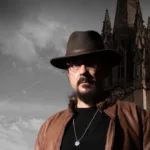


















Oxford-based singer-songwriter, guitarist and producer John Goldrust has spent much of his musical life exploring the space between known traditions and more experimental ideas. Drawing on rock, indie, funk and blues, alongside the older styles of classical and folk music, his songwriting brings together a wide array of influences with a literary approach to lyrics. Inspired by the poetic storytelling of Bob Dylan, Lennon & McCartney, Suzanne Vega and Tracy Chapman, John has also maintained an interest with electronic dance music, giving his work a wide musical perspective that’s unlike any other.
His avenue towards songwriting was not entirely conventional; theatre and performance, including dance, mime, comedy and acting, formed the basis of his early creative instincts, while his musical education included choral singing, piano and saxophone. It was the discovery of folk and rock guitar, however, that brought those interests into focus, with the instrument opening up a more direct means of expression, leading him towards a life as both a solo singer-songwriter and a rock and blues vocalist and guitarist in several bands during his teenage years.
An academic path through school and university initially took John in a different direction but his desire to pursue music continued to grow. By not viewing songwriting through traditional methods alone, he began looking towards the abstract principles of mathematics and physics, applying ideas from his studies to the structure and opportunities of music.
His curiosity eventually developed into a new theory of music, centred on reducing the medium of song to its essential elements and that interest in the underlying mechanics of music would become an important part of his creative vision, connecting intellectual exploration with the emotional sphere of songwriting.“If I was to describe my sound, it’s like Led Zeppelin meets the Arctic Monkeys, but in an alternate universe. Think of a Black Sabbath tribute band at a Biker’s wedding, only the band have replaced all the words with the Beatles lyrics, but no one has noticed yet,” he shares.
After spending time in Brighton as a sales team leader, John returned to Oxford and formed the band Pulsar, which played several gigs before eventually disbanding. He subsequently created a home studio and began exploring electronic production, working with a dance music collaborator on the Happy By Design EP. His first official track, “When Said Is Done,” was recorded in his garden studio with musicians from the former Oxford reggae band Mackating, featuring British reggae artist I-Lodica on vocals and melodica.

The most substantial undertaking of this period has been his album titled Like A Phoenix, released after ten years of recording and production at The Goldrust Records studio. The eleven-track outing reflects what John describes as his quest to attain the meaning of life while facing the difficulties of being an independent artist searching for a record deal. Penned largely across the same decade in which the album was made, its songs document loves, losses, relationships and the personal explorations that shaped those years.
The battle between good and evil, the search for a modern equivalent of the Holy Grail, spiritual awakening and personal emancipation all inform its wider themes. The album’s opening track, “The One For Me,” offers an intimate entry point into those ideas, with John describing it as a love letter to someone he’s yet to meet, imagining a future romance as though time itself were running backwards. The track revolves around the fragility of life’s journey and the relationships that might, or might not, arise along the way. Made alone in his studio, it initially felt too minimal to him, prompting him to invite friend Paul Humphries to contribute piano.
Tracks like “Like Yesterday” capture John’s timeless songwriting style in a laid back arrangement of intricate guitars and mellow percussive energy. “Mystify The Light” casts a brooding rock scene where the moody twang of guitar and march of drums underpin John’s expressive vocals while “How Like The Goddess” rolls with pattering rhythms, bouncy guitar layers and smooth vocals carrying memorable melodic leads.
The album closes with a live version of “Mystify The Light,” bringing a performance element into a record otherwise shaped by an extended period of studio work. Beyond Like A Phoenix, John Goldrust’s plans remain open, although live music is firmly part of the picture. He’s long imagined a travelling circus of musicians taking performances around the world, an intriguing alternative to conventional touring, shared with a team of like-minded souls.
Listen to Like A Phoenix below
More from Albums

INTERVIEW: FKA MASH drops debut album ‘EXITECHNO’
Growing up in Soweto in South Africa, FKA MASH discovered electronic music through the unlikely playground of early production software …

New full-length record from Divergent
While some musical ambitions take a little longer to find their moment, the journey for Iowa-based trio Divergent has been …
New album from Ashot Danielyan
Based in Moscow, pianist, composer and improviser Ashot Danielyan has spent more than a decade developing a musical output that …