

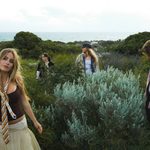

















Spanish-Equatoguinean singer-songwriter and producer Böitaari has been creating a musical offering informed by cultural connection, experimentation and an exploration of the emotional spheres of sound. Born and raised in Spain and now based in the UK, she presents a unique position between different musical worlds, drawing on her Equatoguinean heritage and ancestral origins in Cameroon, Sierra Leone and Cuba. As the daughter of parents from Equatorial Guinea, the only Spanish-speaking country in Africa, her work reflects a personal connection to traditions that extend beyond geographical borders.
Through a bright combination of Afro Latin, Caribbean and Mediterranean influences, she creates music that feels at once tethered to her background and open to exploration. A multi-instrumentalist and producer, Böitaari views songwriting as a form of cultural storytelling; Bubi culture plays an important role in her artistic identity, finding expression alongside rhythms and melodies drawn from a wide range of traditions.
Her sound is highly unique, often sultry and consistently adventurous, with each release offering an opportunity to explore different textures while keeping sight of the emotional substance within them. It’s a musical output that brings together technical versatility and personal expression, allowing listeners to experience the physical impact of the rhythms while connecting with the multilingual stories carried by her lyrics.
The relationship between identity, emotion and experimentation now comes into especially sharp focus on La Autognosis de Reine Grevyi, Vol. 1, a four-track Afro Mediterranean EP that brings music, surrealist painting and self-discovery into conversation. Released through her independent imprint Bilëbbó Fusión, the EP moves across Ghetto Zouk, Kizomba, Flamenco, Congolese Rumba, Moroccan Gnawa and Cameroonian Mbolé. Each tradition retains its own character, allowing Böitaari to explore their individual qualities while revealing the connections that ripple throughout the project.

The four compositions were initially created as separate songs and it was only as they developed that an unexpected common thread arose, revealing a portrait of emotions and experiences that Böitaari had not yet fully understood. That discovery became the spark for the EP, turning a collection of individual musical ideas into a wider process of personal investigation. The project also introduces Reine Grevyi, the visual art identity through which Böitaari explores another dimension of her creative practice and by not representing a separate artist or fictional collaborator, Reine Grevyi serves as an extension of the same creative identity across painting, photography, videography and creative direction.
Opening track “Bruma” maps out the project’s atmospheric approach through cinematic Ghetto Zouk, enriched by arabesque and symphonic arrangements and capped by lyrics in English, Portuguese and Spanish. Thematically, it considers the uncertainty and ambiguity of an undefined relationship, captured in a moody soundscape where pattering percussion and playful piano lines combine below Böitaari’s rhythmic vocal delivery.
“Caoba” moves towards the meeting point of Kizomba and Flamenco, combining Spanish guitar with traditional vocal elements including quejíos, jaleos and handclaps. Its personal confession, kept unspoken for years, gradually dissolves into a fragmented and abstract outro, turning memory into sound. On “Legendaria”, Böitaari draws from the orchestral traditions of Congolese Rumba, particularly the musical legacy of Franco Luambo and TP OK Jazz and within its warm, celebratory instrumentation sits a more uncomfortable reflection on recognition, considering the chance that an artist might receive greater appreciation after death than during their lifetime.
The closing instrumental, “Élan,” brings Moroccan Gnawa into dialogue with Cameroonian Mbolé. Guembri, qraqeb, percussion, synthes, electric guitar and vocalisations combine in an exploration of movement, ecstasy and release, with co-production and arrangements from the Bilëbbó Fusión collective RHODOKROSA. As the EP moves from multilingual storytelling into an instrumental finale, Böitaari arrives at a point where words are no longer required and thus, La Autognosis de Reine Grevyi, Vol. 1 ultimately captures an artist examining the many dimensions of her identity, using music and visual art as complementary ways of understanding and expressing the experiences that shape her.
Listen to La Autognosis de Reine Grevyi, Vol. 1 below
More from EPs
New EP from Xeno Ray JNB
The path of Xeno Ray JNB has been paved by experimentation, personal transformation and a desire to follow a unique …

Alwyn Morrison shares ‘Trial’ EP
Based in New York City, Alwyn Morrison has created his musical offering around a talent for observation, drawing inspiration from …
New EP from J.Scott
Originally hailing from Jacksonville, Florida, J.Scott has spent his musical journey exploring the space between classic vocal influences and modern …