







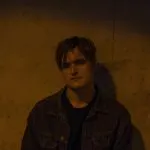










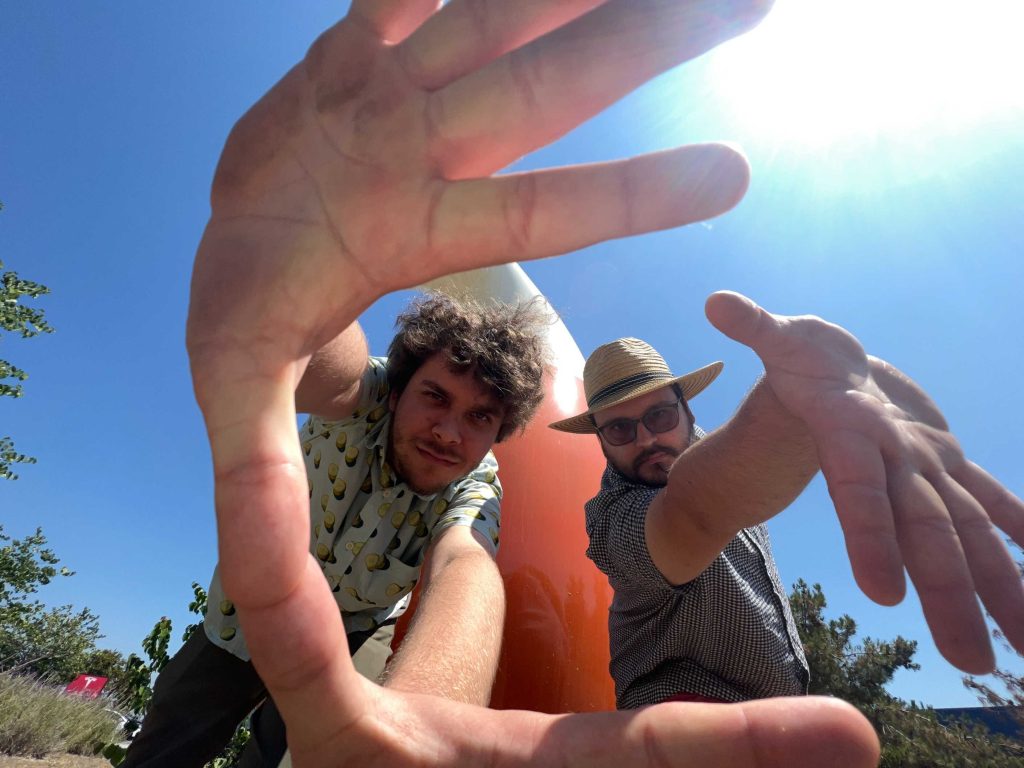
San Diego’s Zhir Vengersky is an experimenter, a musician who prospers on bending structure and rethinking how songs can take shape. Operating under the banner of Real Fake Music, his work is a study in organised chaos, where deliberate play collides with subconscious flow and where each record feels like a new detour into uncharted territory. Since stepping onto the scene in 2020 with his debut album All-American Criminal, Zhir has earned a reputation for thoroughly unique expression, building a catalogue unlike any other.
Over the past five years, he’s released multiple EPs and full-length projects, each one expanding on his vision of experimental rock that brushes against the edges of art punk and avant-garage. His music carries the edgy energy of early post punk while embracing the theatricality of art rock and the noise-drenched textures of analogue synth experimentation. It’s a sound that feels at once intricately constructed and barely held together, capturing the sense that Zhir is always chasing something just out of reach while inviting listeners along for the ride.
His latest project titled Farewell, My Lovely, arrives as perhaps his boldest left-turn yet; conceived in a whirlwind of hypnagogia, train journeys, virtual anime muses and the hardboiled themes of Raymond Chandler novels, the album trades deliberation for instinct. Written and recorded across just six months, three spent on lyrics and three on music, it’s the fastest Zhir has completed a record since his debut. After the painstaking work behind 2024’s Behind Every Drive-Thru Window in the World, which took a year and a half to write and refine, this time he let his subconscious steer the process.
Central to the album’s creation was a set of “guiding light principles” that defined both its spirit and its structure. Borrowing from David Thomas’s Chinese Whispers methodology, Zhir laid down rules that deliberately stripped away excess and forced immediacy, among them: “deliberation is the enemy of the process,” “the best guitar part is the one that requires you to move your fingers the least” and “just because you can doesn’t mean you should.”
Recorded at Vengersky HQ and Love Beach Annex, Farewell, My Lovely is entirely self-produced, arranged and performed by Zhir himself. Across its tracks, acidic melodies twist against loose song structures, while emotive, often theatrical vocals cut through walls of synth noise and distorted guitar fragments. At times it feels abrasive, at others eerily beautiful, but always bound to its own internal logic.
From the atmospheric buzz and shuffling groove of opening track “26 and Balding (Going Bovine),” the album glides with the intriguing blend of pulsing rock rhythms and bright synth textures capped by expressive vocal leads. “Carrizo Gorge” sees Zhir collaborate with Monsieur Herr for a psych-tinged art rock outing built on laid back rhythms and cut with spacey vocal processing.
Tracks like “Macht Schau (Kanon),” see Zhir lean into his synth pop stylings with a bouncy jam of synth-driven arrangement peppered with funky guitar flickers and subtly theatrical vocals. “Bleak (Another Face in the Glass)” offers a hazy finale of stripped back experimental rock where the twang of guitar, fuzz of synth and sparse spoken word style vocals combine to form an engaging conclusion to his fascinating new album.
We caught up with Zhir Vengersky to find out more about his musical journey so far, his new album Farewell, My Lovely and what he’s got lined up for the future. Check out our interview with Zhir Vengersky below.

Hey Zhir Vengersky, how’s things?
I’m surviving. And as a citizen of the United States in the 21st century, that’s the most you can hope for.
What’s your earliest memory of making music?
Trying to figure out a really primitive version of GarageBand on iOS when I was 14 or so. I can’t remember what the first serious song I wrote was… I just remember a lot of frustration with both myself and the program, because neither I nor it could do what I wanted to do.
Which artists do you draw most inspiration from?
At present: Pere Ubu, Slugbug, Arto Lindsay, and Zvuki Mu.
How else do you find inspiration for your music?
I read old novels, or listen to the audio versions thereof. H.G. Wells, Joseph Conrad, Jim Thompson, and Raymond Chandler are all in regular rotation. I drive out into the backcountry via decommissioned highways and auto trails, and I take photographs and notes of what I see and what I don’t see. Sometimes I’ll build around a phrase I think sounds good. Otherwise, I wait. Inspiration cannot be forced.
What’s been your highlight for the year so far?
In late June/early July I went to Burbank to meet with some musician friends. They had access to a piano that belonged to Jack White (still sounded great), and a guitar that belonged to Jackson Browne (absolutely dilapidated). I got to play both. We spent the whole week jamming on “Shortnin’ Bread”.
What would you say is the perfect setting for listeners to enjoy your sound?
Late at night in the middle of a surround-sound system at maximum volume. Nobody else in the room.
How has your own style and sound evolved since you started out?
Every Zhir Vengersky release is the absolute best I’m capable of at that moment in time not only as a songwriter, but also as a producer and engineer. In the five-ish years I’ve been doing this I’ve gone from nil to reasonably adept in all respects. I started off thinking I was going to be some sort of zany zolo-punker, but the Path I found myself on was leading somewhere darker, more abstract, more abrasive.
How did you find making your new album ‘Farewell, My Lovely’?
Behind Every Drive-Thru Window in the World was released around the same time production began for Farewell, My Lovely, and those who had heard the former in advance were calling it my “magnum opus”. Well, that’s a rather high bar to set. There’s a subconscious stress when trying to determine where to take your art next after hitting such an apex. Whatever direction you take, it’s going to feel like a step backwards, or downhill. I decided that the Right Course was to put together an album that was nothing like the previous one, while still being identifiable as my own work. I gave myself a set of ten “guiding light rules”, based on David Thomas’s Chinese Whispers methodology, specifically designed to curtail second-guessing myself. Among my rules were “trust the first idea you get”, “deliberation is the enemy of the process”, and “don’t worry, it’ll work out”.
As someone who is not great at improvisation and can succumb quickly to “analysis paralysis”, I had absolutely no idea what to expect from restricting myself in this way. I found pretty quickly that with these self-imposed limits (and a deadline, too: I gave myself three months each to write the music and lyrics) I was more confident in the material as it came together. Allowing dreams, and even hypnagogia, to inform the album’s direction was nothing short of a boon. I’d been wanting to break from the “I hate rich people” rants that comprised the great majority of my back catalogue, and what I would see while I was asleep provided a buffet of lyrical fodder. “Fallbrook”, “Tarantula”, and the title track are the best examples of this.
What message did you want to get across with this release?
There was no intention of a message behind this album. Quite the opposite, in fact. Any “message” heard is entirely in the audience’s mind. That’s not to say the album or the songs say nothing about me, or who I am, or how I think–that is unavoidable in art–only that it’s not deliberate.
What artist have you been listening to most recently?
Pere Ubu, Monsieur Herr, Rage Against the Machine, and Glorb.
What’s the main thing you want people to get out of listening to your music?
Disturbance if they’re comfortable, and comfort if they’re disturbed.
Do you have any advice for a new artist wanting to follow your footsteps?
The audience doesn’t matter. The only thing you should do is exactly what you want.
Finally, what do you have lined up for the rest of the year?
Chip away at the next album. Build microphones out of junk components. Work on restoring the Jackson Browne-provenant guitar. Try not to get sent to El Salvador for believing in freedom and human rights. Smoke a beef brisket on a Wednesday.
Listen to Farewell, My Lovely below
More from Albums

New full-length record from Divergent
While some musical ambitions take a little longer to find their moment, the journey for Iowa-based trio Divergent has been …
New album from Ashot Danielyan
Based in Moscow, pianist, composer and improviser Ashot Danielyan has spent more than a decade developing a musical output that …

Bryan Howell returns with new studio album
Originally hailing from central New York and now based in Nashville, Bryan Howell has spent more than a decade developing …