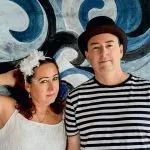









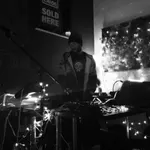

From the fringes of sonic and visual exploration comes Bgerosani, the artistic banner of Georgian-Swiss composer and experimental musician Demetre Gamsachurdia, a Basel-based artist whose output glides between the organic and the artificial, the ancient and the futuristic. Born in Tbilisi and informed by Georgia’s vocal traditions, Bgerosani has spent years transforming those microtonal harmonies into something that reaches far beyond folklore, creating a sonic universe where ambient textures, electronic noise, metal and modern classical collide in hypnotic waves.
His compositions often abandon traditional notation, instead progressing through live performance and improvisation, allowing each piece to take shape as an act of discovery. His creative life has been marked by constant motion and collaboration; having worked with figures such as Heinz Holliger, Fred Frith, Giya Kancheli and Georg Friedrich Haas, he’s earned a reputation as a visionary composer who operates at the overlap of genres and disciplines. His music has travelled from the concert halls of Switzerland and Poland to festivals in Germany, Brazil and China, performed by ensembles like Geneva Camerata, Ensemble Phönix and the Raschèr Saxophone Quartet.
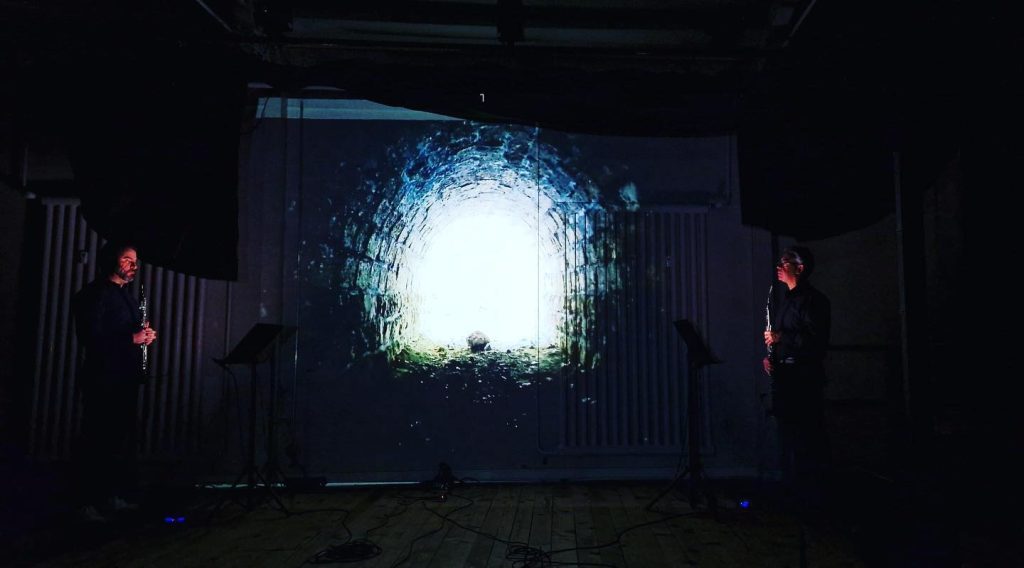
Under the Bgerosani moniker, his work has grown even more conceptually adventurous and his recent project titled “Savage Simulacra”brings together performance, sound, video and artificial intelligence into a single immersive experience. Commissioned for the Oboes Migrantes project, the piece features amplified oboists Vicente Moronta and Ricardo Ribeiro alongside Bgerosani himself on live electronics and video production. Recorded in Geneva, the piece feels a living installation, presenting an audiovisual descent into the surreal and wholly absorbing.
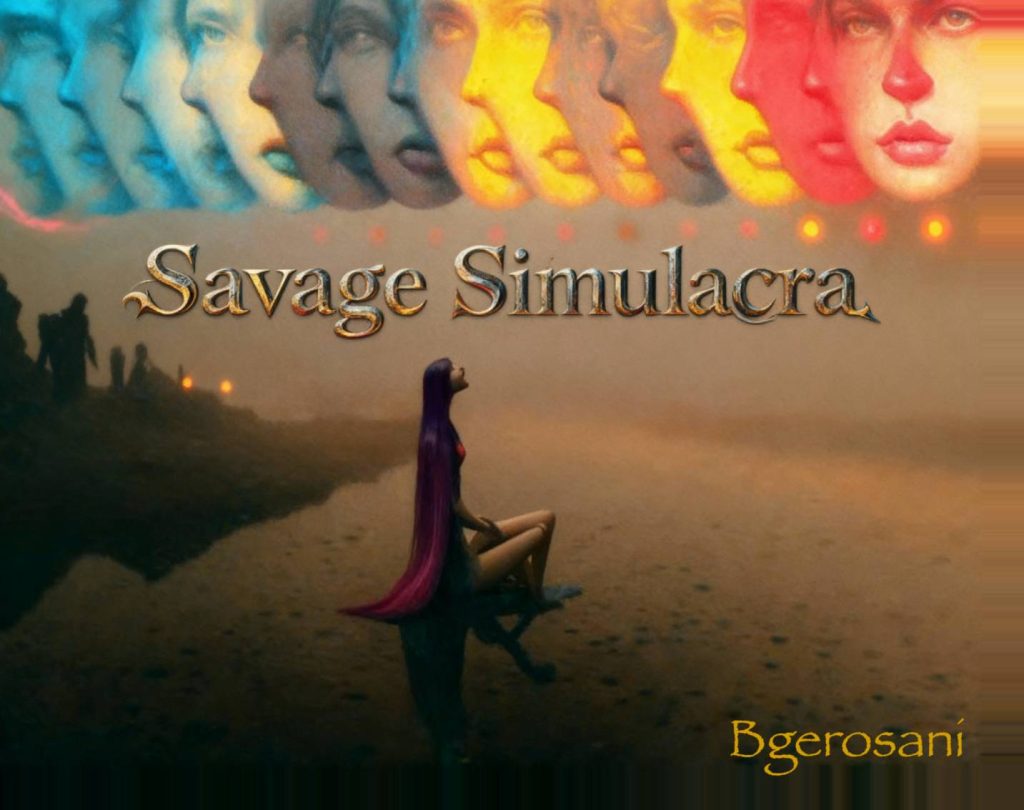
In “Savage Simulacra,” the physical and digital worlds bleed into each other and using generative tools such as Heygen and Runway for visual creation, alongside audio mixing by Arturo Corrales, the work embraces AI not as a collaborator. Thematically, it explores a world where images, sounds and rhythms fracture and recombine, reflecting the disarray of the digital world around us. Drawing inspiration from Fausto Romitelli, Horatiu Radulescu, Jay Schwartz and Lou Reed, the piece fuses spectral techniques with hypnotic rhythms, bending perception until the listener can no longer tell where sound ends and vision begins.
The video component, influenced by Hieronymus Bosch’s The Garden of Earthly Delights, expands the sense of otherworldliness, its kaleidoscopic imagery shifting between beauty and dissonance, mirroring the score’s uneasy harmony to capture a meditation on the overload of information and imagery in contemporary life. Through this collision of media, “Savage Simulacra” presents a challenge to the listener’s senses, encouraging them to question what is real and what is illusion.
The fifteen minute audio-visual experience takes listeners on a truly engrossing voyage that flows through moments of stripped back avant-garde composition to experimental electronic vibes cut with the organic flutter of instrumental performance. Paired with abruptly shifting visual sequences, the video flickers between and real world shots and abstract scene to cast a sense of reality distortion that perfectly amplifies the context of the music. It’s a spectacular slice of groundbreaking creative expression from a pioneering artist who continues to operate at the forefront of imaginative endeavour.
We caught up with Bgerosani to find out more about his musical journey so far, his latest project “Savage Simulacra” and what he’s got lined up for the future. Check out our interview with Bgerosani below.

How do you find inspiration for your music?
I don’t. I just take in every bit of life – and sometimes get smacked in my face for it! The good thing is, no matter if I fail or succeed, anything I experience can power art, like electricity powering a light bulb. The same thing that makes me feel alive fuels the music I make. Maybe that’s one reason why artists who lived through tough times used it to their advantage, it gave that cutting edge to their creation. In my case, I experienced the nineties civil war in Georgia as a child which made my family leave the country for many years. Regardless, I think I’m pretty spoiled compared to folks who couldn’t go abroad at that time. Through the years, I’ve been lucky to meet some extraordinary people and learn so much. That is my biggest inspiration.
What’s been your highlight of 2025?
Playing at the Dadiani Palace in Zugdidi, Georgia in autumn.
What would you say is the perfect setting for listeners to enjoy your sound?
You can listen in any way you like. However, body positioning is crucial because it can help you plug into the sound more deeply. Yes, sitting is a jack-of-all-trades, but let me explain. With some tracks, if they’re silent and meditative, lying down can give you a whole different experience, because it’s easier to relax the body and be in tune with the music. With other tracks, if they’re outgoing and rhythmic, listening while standing and moving is a better choice. All this is a natural thing, if you listen to your body you’ll know what to choose and when.
How has your own style and sound evolved since you started out?
I started as a classical musician with a background in Georgian polyphonic singing, an ancient practice that has been part of my childhood. Although I still love, and still play classical concerts to this day, I found myself discovering a whole lot more in different styles and genres. Finding a unique musical language has always been a task I challenged myself with. To tell a story in a new, unheard of format is very exciting. Later, I began producing electronic tracks in addition. Music is a vast universe in which we are small visitors. I don’t think we’re really creating, it seems like there are only discoveries. The music I perform in a sense doesn’t belong to me – although legally it does. How could a frequency sent through air belong to anybody anyway?
It just exists. Like the source code within sound. It just is, it can be found if we search, I believe it even wants us to find it. We’re like radio stations, just tuning in and out of things. So, yes there have been changes over the years, I often use specific tunings from Georgian polyphonic music in the compositions, electronics play a bigger role today although I still write music for piano as well. There are things that can’t be said in words, but sound can express them powerfully. What an unreal advantage having music by our side!
How did you find making your new single “Savage Simulacra”?
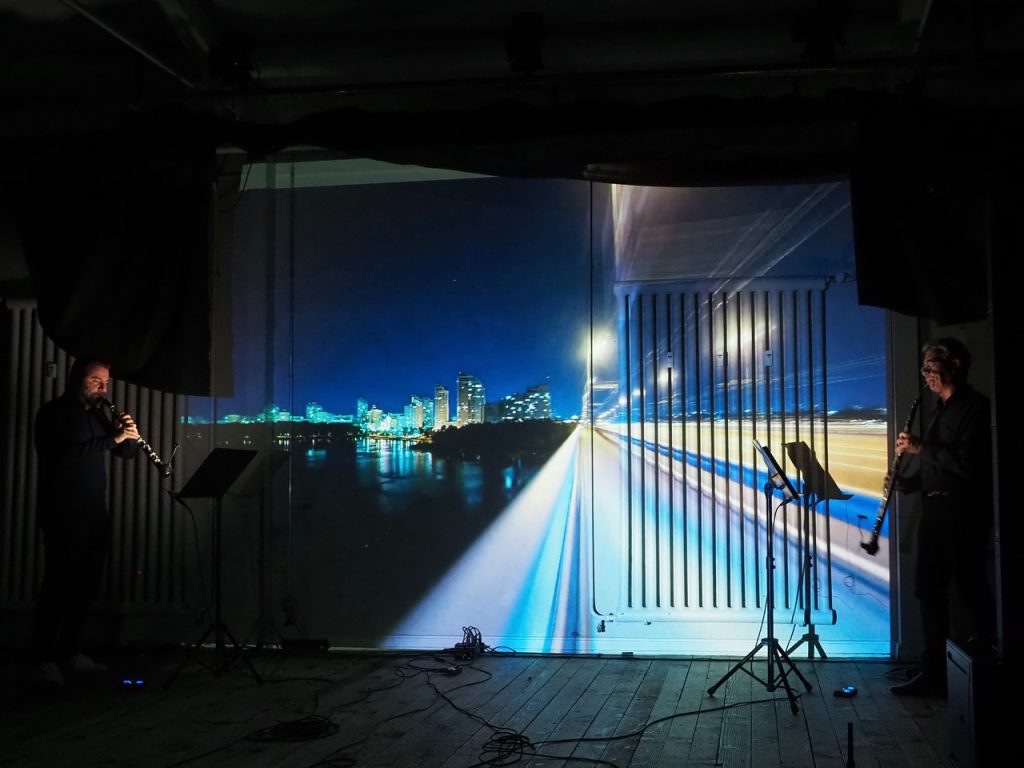
It started as a live performance with the oboists Vicente Moronta and Ricardo Ribeiro. They play along the electronic playback. For some reason, this time not a single normal sound was placed in their part, it all consists of multiphonics, a playing technique where the usual focused single note is broken down into a complex cluster of sound. Now, Vicente and Ricardo are great musicians and they enjoyed it. The oboes are then amplified and mixed into a greater web where we have soundscapes moving according to a specific Georgian microtonal tuning as well as a ceaseless rhythm using signature eighth and quarter tones.
For the video, I used lots of different live camera footage, with an AI generated part as a central piece. It depicts the universe of Hyeronimus Bosch. Thanks to AI, every single figure and object transforms rapidly and nonstop during the whole passage, something that would be insanely hard to achieve traditionally. This never-ending changeability is not only a key characteristic of “Savage Simulacra”, its basically what I believe is part of a so called dream-logic. If we’re able to pay attention, when we encounter someone or something in a dream, they seem to change every time we look. This applies similarly to visuals in hallucinations, psychedelics, meditation. I believe such states of mind enable us to experience a weird but important part of reality: ceaseless change of what we think is constant.
What message did you want to get across with this release?
This piece of music along with its visuals is an attempt to “poison” the human mind by questioning the relentless onslaught of infinite content in today’s world, inspiring it to break free from concepts, identities and labels. I want the audience to live through the fast paced changeability of the images and feel the hypnotic pull of this music. I want the listener to perceive this way going through the madness, a journey that calls us to return to a sovereign, self-authored, intuitive state.
What’s the main thing you want people to get out of listening to your music?
In today’s world, our attention is a precious currency. There is a war going on, everybody and everything is preying on our attention. Everywhere we look, there is something to capture our interest. Whole platforms are built on science and technology on how to perfect this. I believe we must claim our attention back. Constant disperse of attention makes the human mind weak. The good part is: art and music in particular, give us the opportunity to truly rest our mind on a chosen thing. Once we slow down and consciously attend something that happens, everything begins to change. I believe this powerful and wholistic experience is part of our nature. With the music I create, I search for ways to access such opportunities. Now please don’t take my words for granted, if you’ve been a casual, part time listener its time to turn it up! Fully immerse yourself in the music you like and try it for yourself!
What’s been your favourite live performance so far?
There’s three that stand toe to toe. I attended a concert where Meshuggah was playing. I never knew that heavy can be so light! Another one that really stood out was a performance by the Kabuki theatre. When every word, sound, action has been polished in such way, that’s undeniable magic. Last but not least, some of the best live performances in my life have been moments when there was no conscious “performance”. Sometimes the music that exists just in everyday life has a level of honesty that’s impossible to find on a stage. In Georgia, some of my friends (especially a group called “Qaldea”) like to sing in such ways, not only in concerts but out of pure enjoyment during random everyday situations. As a performance artist, this is humbling and educational in the same time.
Do you have any advice for a new artist wanting to follow your footsteps?
Don’t! Find your own way and follow it. The moment you realise you’ll always stay a total beginner you know you’re on the right path! In spite of all the difficulties, there genuinely is so much happiness in being new to everything. Its much more important to enjoy the journey than to pretend to be somewhere you’re not. We are all explorers in today’s world, and the art, the music we create today will shape tomorrow. That’s what matters right now.
Finally, what do you have lined up next?
Since 2024, I’ve been working on a large scale piece in seven parts, called “Paskundji”. It is inspired by Georgian mythology and features the idea of a great bird, the Paskundji. This creature can carry human being and travel between dark and bright worlds. Honestly I’m not sure if I’ll manage to pull it off during my lifetime as its the most demanding piece of music I’ve ever been in touch with! I might be able to complete three or four parts though and I’m happy to give it a go as it’s incredibly meaningful for me. The first part featuring live electronics is finished by now (watch the trailer here).
I performed it in Tusheti, one of the most remote regions in the Caucasus mountains, an absolute highlight of last year which I’ll never forget. Right now we’re working on the second part which will have a bigger scale than the first. If we manage to follow through and don’t slip, we’ll perform in Tbilisi next year.
For 2026, I want to release a new album called “Ghost in the Cell”. It is inspired by Frederic Rzewski’s “Coming Together” as well as the Japanese anime classic “Ghost in the Shell”. It is the result of more than three years of work, featuring texts by Samuel Melville and Merab Kostava. After tours in Switzerland and Georgia, a video of the first track is just about to release (watch it here). The album will showcase spoken word, fusion jazz, elements of noise and metal as well as experimental ambient as part of a fresh, original combo.
Both of these projects are deeply personal and life-changing for me. They relate to the international turmoil going on at the moment. They are reflections of perseverance in spite of conflict caused by the heavy and dense situation in Georgia.
Watch the visuals for Savage Simulacra below
More from Interviews
INTERVIEW: TATE SEDAR drops “Take It All Back”
Born in San Francisco, raised in London and now based in Los Angeles, TATE SEDAR has spent much of his …
INTERVIEW: Cinematic conceptual album from INYO
Coming out of Los Angeles, newcomer INYO is an artist whose musical vision is informed by a desire to explore …
INTERVIEW: Brand new single from Thomas Azier
Dutch singer, composer and producer Thomas Azier has spent the last twelve years making an impression in the European music …