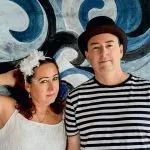











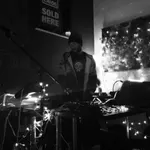

While partnerships arrive with carefully mapped plans, others simply pick up where they left off, resuming a creative journey strengthened by time. Year after first crossing paths and collaborating on acclaimed recordings, West Tennessee songwriter and guitarist Elam McKnight and Nashville-based harmonica player Bob Bogdal now return with music that remains firmly tethered to place, memory and the people whose stories seldom receive the attention they deserve.
Elam has long been informed by the musical stylings of West Tennessee, a region where genre boundaries have never mattered all that much. Blues, country, rock and rockabilly are all parts of the same musical language, naturally colliding until distinctions become irrelevant. That approach has taken him well beyond Tennessee itself and over the years he’s toured throughout the United States and internationally while performing alongside respected figures from the blues world.
His 2011 album Zombie Nation marked an emphatic moment, produced at The Switchyard Studio in Nashville by Grammy-winning producer Tom Hambridge alongside engineer Michael Saint-Leon. After dedicating more than a decade to family life, he returns carrying a new sense of creative purpose. His latest work turns its attention back towards West Tennessee, drawing inspiration from the realities facing the communities that continue to define both his music and his identity.
Alongside him stands Bob Bogdal, whose harmonica playing has become synonymous with expressive Southern blues traditions despite originally growing up in Syracuse, New York. Having spent more than two decades based in Nashville, Bob has established himself as one of the city’s versatile roots musicians, bringing an understanding of restraint as much as virtuosity. His playing never overwhelms a song; each note feels carefully placed, adding atmosphere and emotional impact with sonic subtlety.
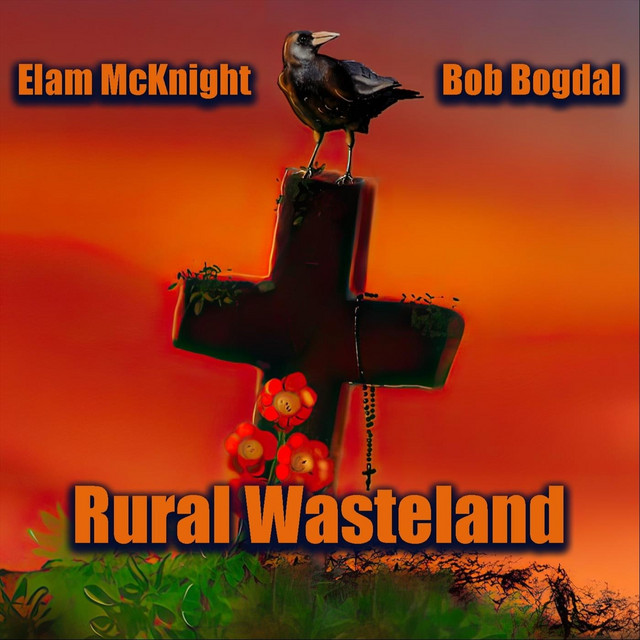
Now reunited, Elam and Bob use their shared history as the platform for their renewed partnership which began with “Pojo’s Place” before continuing through the new single titled “The Rural Wasteland,” a song that shifts attention towards the changing realities of rural America. “The Rural Wasteland” focuses on the people living through its difficulties and against the backdrop of continuing economic pressures affecting America’s farming communities, the song examines the human consequences of industrial consolidation, shifting tariffs and systemic neglect.
The pair avoids reducing those issues to political talking points, with Elam and Bob concentrating on the emotional impact carried by families whose livelihoods and generational legacies have gradually slipped away. Set up by the strike of drums, the track jumps into a bright country scene where shuffling percussion, walking basslines, playful harmonica and piano rolls below Elam’s wam vocal leads. Dashed with slick guitar flickers and wrapped in a buoyant musical fabric, the pair frame the sombre context of the song in an upbeat setting providing a contrast that’s truly engaging.
Recorded at The Switchyard Studio in Nashville, the track glides with catchy vocal hooks, a twanging guitar solo and carries a timeless country pop sound which sees Elam McKnight and Bob Bogdal turn a pressing topic into a joyous musical moment that’s impossible not to love. It’s a spectacular showcase of their enduring songwriting and performance talent, resulting in a superb jam that’s sure to win over listeners around the world while shining a light on an important situation.
We caught up with Elam McKnight and Bob Bogdal to find out more about their musical journey so far, their new single “The Rural Wasteland” and what they’ve got lined up for the future. Check out our interview with Elam McKnight and Bob Bogdal below.

How did you get together as a duo?
Bob and I met around 2008 and started playing shows together, then began working toward an album. In 2011 we recorded at Switchyard in Nashville with producer Tom Hambridge and my longtime collaborator and good friend Michael Saint-Leon. It got a lot of airplay and did really well.
What’s your earliest memory of making music?
My first real influence was Johnny Rivers’ Whiskey à Go Go — that’s what made me want to pick up a guitar, around age fourteen. Then a friend had a black cassette with an orange label: John Lee Hooker. That sent me digging deeper into the blues — Robert Johnson, Muddy Waters — and I realized I was from the actual home of that music, in West Tennessee. That’s when I knew I wanted to honor the music of my own area.
Which artists do you draw most inspiration from?
My influences are varied, but they always tie back to the music made within about 150 miles of where I grew up in West Tennessee — blues, country, rockabilly, rock and roll, and the soul sound coming out of Memphis in the ’60s and ’70s from Stax and Willie Mitchell at Royal Studios, and artists like Otis Redding. I see what we do as carrying on what they started. The Bakersfield country touches on this album were a conscious choice — I’d written some more country-leaning songs and wanted them to have their own stamp. The Byrds’ Sweetheart of the Rodeo and the Gram Parsons catalog were touchstones there.
How else do you find inspiration for your music?
I’m a big reader and film buff. Steinbeck’s The Grapes of Wrath and Of Mice and Men — the books especially — shaped how I think about what people went through in the Depression, and how those situations repeat. My grandparents lived through the Depression and were a big influence on me directly; I made an earlier album with my daughter about our great-grandfather raising a family through that era. Music has to come from a real place — it needs some bark on it, some backbone. That backbone is what gets reflected back in the lyrics and the tone.
What do you love about the Tennessee music scene?
Tennessee — I’m from near Jackson — does a real good job of keeping live music alive. And the history runs deep: Sleepy John Estes, Yank Rachell, Hammie Nixon, Carl Perkins — I grew up around Carl Perkins, watching him play. Being immersed in that tradition, knowing it’s influenced musicians all over the world, makes honoring that lineage feel important. I know Bob feels the same way.
What would you say is the perfect setting for listeners to enjoy your sound?
Riding in the car, watching the landscape go by — or sitting comfortably on the front porch with it cranked. But more than the setting, I want people to sit with the whole album. We’re a singles-driven culture now, but an artist makes a full record as one work — treat it like a novella, something you sit down and go through complete. Singles are fine, but that’s not how the work was intended.
How has your own style and sound evolved since you started out?
Our first album as Zombie Nation was harder hill country, traditional Delta with some acoustic, one country song. For The Rural Wasteland: Postcards from a Zombie Nation, Bob and I talked about getting back together with a new concept and, it turned out, a new sound. It’s a little less hard and raw, more cinematic — especially in how we’re filming the videos. But it’s not more concept-driven than before. We were already talking about these issues back in 2008–2009, leading into the 2011 record, and they’ve only gotten more pressing since. We’re just sending dispatches from our area — that’s what artists are supposed to do, hold up a reflection of what they see.
Who would be your dream artist to collaborate with?
Dave Cobb. What he’s done with Chris Stapleton, Sturgill Simpson’s Metamodern Sounds in Country Music, Jason Isbell’s Southeastern — the sound he gets is spectacular. He also helped preserve RCA Studio A in Nashville, where Elvis recorded — that’s holy ground. If you’re reading this, Dave — let’s make it happen. Probably won’t, but I’m allowed to dream.
How did you find making your new single “Rural Wasteland”?
I wrote it back in 2013, recorded the basic tracks in my own studio in 2014, and it sat on the shelf a while. The session itself was great — Gaylon Doss, who I think of as the Country Drummer, a local drummer who plays those six-hour country dances, came in and we cut the basic tracks together. From there it went to Clifton Broadridge.
What message did you want to get across with this release?
Rural decline — the opioid crisis, economic abandonment in our region. I grew up around grandparents who lived through the Depression, and we’re watching that cycle come back through the loss of family farms and the infrastructure that used to support rural communities. I want people to feel more concern for each other and a push toward rural people organizing together instead of staying divided — we’re all in the same boat, and if we don’t steer it, it isn’t going anywhere.
What artist have you been listening to most recently?
A lot of the newer country — Tyler Childers, Sturgill Simpson, Charley Crockett — it’s encouraging to hear people taking it back to real country and also expanding the boundaries of that. Also a lot of jazz, Miles Davis especially. The Allman Brothers, old Delta blues, sitting on the porch music — Dock Boggs, Hank Williams, and the field-recorded hill country players nobody knows by name. I was lucky enough to be around some of those people in real life, not just on record, and I think that variety is what gives you ideas.
What’s the main thing you want people to get out of listening to your music?
Same as the single’s message, really — more concern for one another, and a sense that rural communities need to pull together rather than stay split into camps.
What’s been your favourite live performance so far?
Playing the blues festival in Thief River Falls, Minnesota, with the Red Lake Nation — four shows total, but that first one was a great crowd and a totally unique experience. I made friends up there I’m still close with. We actually recorded that first show as a live album, Live from Thief River Falls. Taking our music somewhere that far from home and being welcomed like that — I’m grateful for it and hope to get back.
Who would be 3 artists to headline your dream festival? And where would it be?
Bobby Rush — one of the last of the old-school greats, still going strong — alongside some of the great younger blues artists coming up now, like Christone “Kingfish” Ingram and Jontavious Willis. I’d want us in that mix too, along with our good friends Kilborn Alley. Location-wise, somewhere in Mississippi, or somewhere in Europe — taking the music to people who know it but don’t often get to hear it live. I’ve played in Europe and felt that, and it’s a different kind of connection.
Do you have any advice for a new artist wanting to follow your footsteps?
Have a plan, set real goals, and know the road is long. Do your research — read actual books, not just the internet. Derek Sivers, who started CD Baby, has short, sharp books on promotion and building an audience — good place to start. Write your goals down and commit to them. Everything that’s happened for us came from a lot of work — one hour on a festival stage might mean forty or fifty hours getting there. Be ready to wear a lot of hats, including ones you’re not good at yet. And be who you actually are — people can tell the difference.
Finally, what do you have lined up next?
The video for “Rural Wasteland” is still coming, and interest in the song keeps growing. We’re releasing “Red Sarong” September 1, with the full album, The Rural Wasteland: Postcards from a Zombie Nation, following in October. We’ve been honored with an invite to play the Deep Blues Festival in Clarksdale, Mississippi, plus some regional shows already under our belt — our biggest push will be spring/summer 2027. The album will go out when it’s ready; records tend to tell you when their time is.
Listen to The Rural Wasteland below
More from Interviews
INTERVIEW: TATE SEDAR drops “Take It All Back”
Born in San Francisco, raised in London and now based in Los Angeles, TATE SEDAR has spent much of his …
INTERVIEW: Cinematic conceptual album from INYO
Coming out of Los Angeles, newcomer INYO is an artist whose musical vision is informed by a desire to explore …
INTERVIEW: Brand new single from Thomas Azier
Dutch singer, composer and producer Thomas Azier has spent the last twelve years making an impression in the European music …