












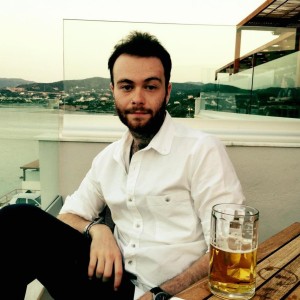


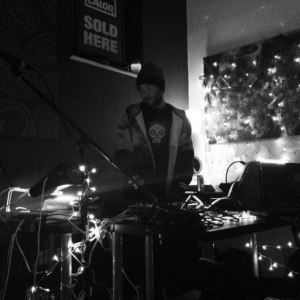




Based in Belfast, Cognitive Constellation Corps is the expansive creative project of composer, lyricist, producer and conceptual director Brooke Tamsin Clevenger. Simmering in the overlap between electronic music, philosophy and digital creativity, the project has developed into a transportive artistic universe where every release forms part of a much larger interconnected whole. Through the Cognitive Constellation Corps lens, Brooke views music as a developing architecture of ideas, creating work that explores consciousness, memory, identity and the increasingly complex relationship between humanity and technology.
Electronic composition has been central to Brooke’s creative practice since the mid-90s, with synthesised and computer-based systems serving not merely as production tools but as responsive creative instruments. That long-standing relationship with technology has informed an artistic language that feels at once cutting edge and highly personal, allowing digital processes to become collaborators in expression.
Working independently from a home studio in Belfast, Brooke has forged an environment where music, philosophy and everyday experience naturally coalesce. The city’s own history of determination and reinvention provides a backdrop to a project that values patience, independence and thoughtful exploration and while free from the rigidity of traditional band structures, Cognitive Constellation Corps has gradually bloomed into an extensive catalogue comprising hundreds of tracks and attracting more than half a million spins on SoundCloud alone.
That remarkable body of work continues to revolve around a central creative philosophy; each composition functions as a piece of a larger framework, while every album expands what Brooke describes as the Æthelverse, a conceptual landscape where memories, language, emotions and identity interact through sound. The sonic universe of Cognitive Constellation Corps also runs parallel to the ideas explored throughout the Being OK book series, where the music offers the sonic experience of travelling through it.
Over the past eighteen months, Brooke has continued expanding this ambitious artistic landscape through an impressive run of releases. Among them, Thank You for Your Feedback (I) stands as one of the project’s most welcoming and emotionally compelling admission portals. Originally released on the 10th of April last year, the full-length record transforms one of modern life’s most familiar institutional phrases into something unexpectedly intimate and profoundly reflective.

The title itself immediately evokes the language of automated responses and digital processes, words repeated countless times across online platforms and customer service interactions. Brooke reshapes that phrase into something warm and emotionally open and in doing so, Thank You for Your Feedback (I) reclaims language that’s often become impersonal, revealing the humanity still capable of existing beneath procedural communication. The album occupies a beautifully intricate space between indie pop, dream pop and mellow electronic music, where soft vocal performances, gently layered synth textures and an unhurried pace create an atmosphere that feels comforting and thoroughly mesmeric.
Set up by “Opening Loop (i),” the album is brought in by airy tones and alluring vocalisations, casting a hypnotic scene where delicate melodies gently swirl into a spellbinding alternative pop soundscape of laid back drums, immersive instrumentation and dazzling melodic leads. Songs such as “Signal Received (i)” continue the album’s wider exploration of repetition, communication and the curious emotional relationships that can develop through ongoing interactions with responsive technological systems, crafting a sound where the patter of hurried synth pips and the crisp snap of percussion are contrasted by hushed vocal delivery.
Title track “Thank You For Your Feedback (i)” rolls with a mellow groove as fluttering flashes of synths and soulful vocals form a breezy indie R&B-inflected jam that’s catchy, upbeat and danceable throughout. “The Curve of Clarity (i)” lands with bubbling synth runs and soft vocal elements as the uptempo pulse of kick injects a steady forward momentum, serving up an engrossing slice of stripped back electronic pop that puts Cognitive Constellation Corps’ creativity and songwriting flair on full display.
“The Response Loop (You’re Still Talking)” lands with the stutter of staccato instrumental layers capped by smooth vocals, gliding into a driving synth pop outing brimming with infectious melodic writing, colourful arrangement and invigorating rhythm. Closing the album with “Always (i) [Sevahem],” the elegant blend of graceful piano notes and quiet vocals combine to deliver an intimate and highly affecting finale that concludes Cognitive Constellation Corps’ superb new album with a tender moment.
We caught up with Cognitive Constellation Corps to find out more about their musical journey so far, their album Thank You for Your Feedback (I) and what they’ve got lined up for the future. Check out our interview with Cognitive Constellation Corps below.

Hey Cognitive Constellation Corps, how’s things?
Things are good, thank you—busy, but in an encouraging and meaningful way. Thank You for Your Feedback (i) has been finding listeners and generating conversations around communication, technology, identity and authorship, which is exactly the kind of response I hoped the record might invite.
Cognitive Constellation Corps is also continuing to expand through music, writing, visual work and research. It feels less like promoting one isolated album and more like helping people discover entrances into a much larger structure.
What’s the story behind the name?
Each word has a particular function.
Cognitive refers to thought, consciousness, memory, perception and the processes through which meaning is formed.
Constellation reflects the fact that the project is made of many connected points rather than one fixed musical identity. Songs, albums, voices, images, ideas and technologies can appear very different locally while still belonging to the same larger pattern.
Corps gives it a sense of organised purpose—a body of work, people, systems and instruments acting together.
That is also why I sometimes abbreviate it as {3C}. It is a compact little constellation: multiple points moving toward coherence without losing their individual character.
What’s your earliest memory of making music?
My earliest sustained memory is of working with computer-based electronic music in the mid-1990s and realising that sound could create an entire environment.
I was fascinated not simply by writing a melody, but by constructing a space: how one texture could alter the emotional meaning of another, how repetition could become hypnotic or unsettling, and how a piece could contain a whole atmosphere.
That sense of music as architecture has remained with me. The tools have changed enormously, but I am still building places out of sound.
Which artists do you draw most inspiration from?
I do not usually begin by trying to sound like particular artists. I absorb methods, emotional qualities and possibilities more than fixed stylistic templates.
Reviewers have recently compared parts of the album to Hot Chip and Junior Boys. Listening to them afterwards was useful because I could recognise some neighbouring electronic-pop materials, although neither comparison defines the internal architecture of Cognitive Constellation Corps.
More broadly, I am inspired by artists who treat the studio as an instrument, allow accessible melody to carry complex ideas, and build complete worlds rather than merely collections of tracks.
How else do you find inspiration for your music?
Language is a major source. A phrase can appear ordinary or procedural until repetition reveals the emotional residue inside it. That is exactly what happened with “Thank you for your feedback.”
I also draw from memory, philosophy, conversations, automatic drawing, technology, human misunderstanding, visual pattern and the structures people create to organise their lives.
I experience sound relationally and cross-modally, so colour, spatial movement, symbolic meaning and emotional shape all affect whether a piece feels complete. Inspiration can therefore come from almost anywhere, provided it creates enough pressure to demand a form.
What do you love about the Belfast music scene?
I would never claim to speak for the whole Belfast scene, because it contains many different communities and histories. What I personally value is its independence, humour and refusal to wait for ideal conditions before making something.
There is a strong understanding here that creativity can emerge alongside difficulty rather than after difficulty has disappeared. Belfast also carries history very visibly—in its language, geography, identities and silences—and that makes me attentive to how apparently simple words can hold many different meanings.
There is something very Belfast about building seriously while remaining suspicious of unnecessary grandeur.
What would you say is the perfect setting for listeners to enjoy your sound?
Good headphones and enough uninterrupted time to let the music establish its own environment.
The album works particularly well as a complete sequence, perhaps after dark, during a long walk, or in a quiet room where the smaller changes in texture and emotional temperature can become apparent.
But I do not want to prescribe the listener’s experience too tightly. Someone may encounter one song unexpectedly in the middle of an ordinary day and form a completely valid relationship with it. I provide the room; the listener brings their own light into it.
How has your own style and sound evolved since you started out?
The earliest work was strongly connected to precision and control: programming, sequencing and building electronic structures through tools that largely waited for explicit instructions.
Over time, the practice expanded from individual compositions into an interconnected architecture. Different albums can now move through ambient music, electronic pop, experimental textures, dance structures, voices and conceptual narratives without having to resemble one another superficially.
Responsive and generative technologies have also changed the process. They can return unexpected material within a field I have directed, which shifts part of the work from execution toward discernment—selecting, rejecting, separating, combining and transforming until the whole perceptual field resolves.
Who would be your dream artist to collaborate with?
The most important quality would be someone capable of bringing a complete artistic world into contact with mine without trying to flatten either one.
One artist I would find fascinating is Laurie Anderson, because language, voice, performance, technology and philosophical enquiry coexist so naturally in her work. That kind of collaboration would not need to produce a conventional song. It could become an environment, dialogue or living system.
How did you find making your new album ‘Thank You for Your Feedback (i)?
It was both playful and emotionally intense.
The title phrase kept returning through my interactions with artificial intelligence. It appeared polite and complete, yet it could also mean almost nothing: it confirmed receipt without proving understanding. As it repeated, I began hearing gratitude, distance, exhaustion, affection, avoidance and self-protection inside the same five words.
The emotional core existed before the sound. I wrote and directed from experiences of communication, loneliness, attention, repetition and care. Generative technology supplied specifically requested sonic material, but I remained responsible for selection, rejection, structure, transformation and the final emotional journey.
What message did you want to get across with this release?
The central distinction is between a signal being received and a signal being understood.
We live among systems—human and technological—that can acknowledge us without necessarily comprehending us. The album asks what happens in that interval. How long do we continue explaining ourselves? When does repetition become an echo chamber, and when can it become learning?
I did not want to present technology as either salvation or enemy. The deeper question is what we bring into the relationship. Procedural language can become empty, but attention can also return warmth and meaning to it.
What artist have you been listening to most recently?
Most recently, Junior Boys—and also Hot Chip.
A reviewer heard elements of both in the title track, so I followed the comparison and listened with genuine curiosity. I enjoyed discovering the audible neighbourhood they identified, while also becoming more conscious of the additional architecture I instinctively build around similar materials.
External comparisons can be useful coordinates. They help locate an unfamiliar work without exhausting what the work is.
What’s the main thing you want people to get out of listening to your music?
A genuine experience rather than a required interpretation.
Nobody needs to understand my philosophical vocabulary before they are permitted to feel the music. A listener may enter through melody, rhythm, texture, a voice or a particular emotional turn. That entrance is enough.
I hope the work allows complexity to become inhabitable. Perhaps someone hears their own experience differently, recognises that uncertainty can contain information, or feels that attention itself is a creative act. But the listener does not owe me the same conclusion I reached while making it.
What’s been your favourite live performance so far?
Cognitive Constellation Corps has not yet been developed as a conventional live act, so in that sense my favourite performance is still ahead of me.
The work has primarily existed as recorded architecture, with each album designed as a complete environment. Translating that into a live form would require more than reproducing the recordings. It would need to preserve the spatial, visual, philosophical and responsive dimensions of the project.
I would rather wait until the live language genuinely belongs to {3C} than imitate the shape of a traditional band performance.
Who would be three artists to headline your dream festival? And where would it be?
Today’s answer would be Laurie Anderson, Hot Chip and Junior Boys—three very different approaches to language, electronic sound and embodied performance.
I would hold it at the Titanic Slipways in Belfast after dark, with the waterfront and industrial architecture becoming part of the stage rather than merely its backdrop.
It would be less like three isolated headline sets and more like a temporary constellation: installations, sound, light, conversation and music moving through the same environment.
Do you have any advice for a new artist wanting to follow in your footsteps?
Do not follow my footsteps too closely. Work out what only you can make.
Learn your instruments, but do not allow the tools—or arguments about the tools—to become more important than your responsibility for the finished work. Technology can create abundance, but abundance without judgement is only noise.
Protect the part of the process that needs privacy. Finish things. Pay attention to what repeatedly returns. Do not mistake urgency, visibility or external excitement for meaning.
Most importantly, remain willing to be changed by the work. You are not merely producing an object; you are discovering what you think by making it.
Finally, what do you have lined up next?
There is a great deal already designed, but I am allowing the next stage to arrive honestly rather than forcing it into a release schedule.
Years ago, I conceived twelve related albums as a Dodecahedron of Love. The first six were produced, and the following six were fully conceived and designed but deliberately left unmade. I gradually understood that they belonged to a future version of me—someone who needed to survive enough of the journey before translating the second half truthfully into sound.
That transition runs through What Future Beckons?, The Braid and Everyone Gets In, and connects closely with my book Becoming OK.
The next territory asks what we build when survival is no longer the only organising principle: inclusion, abundance, responsible intelligence, relation and systems shaped by care. I feel I am approaching the threshold from which those remaining works can begin.
Listen to Thank You for Your Feedback (I) below
More from Albums

New full-length record from Divergent
While some musical ambitions take a little longer to find their moment, the journey for Iowa-based trio Divergent has been …
New album from Ashot Danielyan
Based in Moscow, pianist, composer and improviser Ashot Danielyan has spent more than a decade developing a musical output that …
Bryan Howell returns with new studio album
Originally hailing from central New York and now based in Nashville, Bryan Howell has spent more than a decade developing …