






















Kaizers Orchestra are a revered Norwegian rock act who’ve always walked their own fiercely original artistic path. Since first sharing their sound back in 2001, the band have built a musical world where rock collides with cabaret, Eastern European influences and a theatrical sense of storytelling. More than two decades later, that universe remains more enticing than ever, powered by explosive performances, unusual instrumentation and a devoted following that stretches well beyond their home country.
The origins were set with Ompa til du dør, a debut album that instantly marked Kaizers Orchestra as something unlike anything else around at the time. Its distinctive combination of styles gave the band an identity that was impossible to separate from their live presence. Alongside electric guitars and double bass, oil barrels and pump organ became part of the sonic arsenal, producing an unconventional sound that helped turn their concerts into thrilling events.
At the centre of that spectacle stands charismatic frontman Janove Ottesen, whose commanding stage presence and storytelling have played a defining role in the band’s live reputation, helping amplify their dramatic aesthetic. Kaizers Orchestra’s songs exist within a wider sphere populated by unforgettable characters, while their performances bring that world to life with a level of energy that’s become central to the band’s identity.
Their story continued to expand through releases including Evig Pint in 2003 and Maestro in 2005, before reaching another ambitious stage with the Violeta Violeta trilogy between 2010 and 2012. Throughout that period, the band continued to push at the boundaries of their musical world without losing the characteristics that made them distinctive in the first place. Then came the farewell.

After an emotional tour in 2013, it seemed that the Kaizers Orchestra story had reached its final chapter and for a band whose music had always felt larger than conventional rock, however, the ending was never quite as permanent as it appeared. In 2023, Kaizers Orchestra made their long-awaited return, proving that the world they’d created still had plenty of life left in it. Following stadium shows in Norway during last summer, the band are now preparing to return to the kind of venues that helped establish their legendary reputation in the first place.
October will see Kaizers Orchestra embark on a European club tour, bringing their famously high-octane performances back to intimate stages across the continent. The timing is particularly fitting, as this year marks the 25th anniversary of Ompa til du dør, the record that launched their musical ambitions and set everything in motion. A quarter of a century on, its legacy can be felt not only in the band’s continuing identity but in the audience that’s remained devoted to their output.
There’s something inherently exciting about taking a band known for explosive performances and placing them back into smaller rooms. After stadium-scale shows, the club environment offers a return to the pure sonic energy that’s defined Kaizers Orchestra from the beginning. The intimacy only makes the theatricality more engrossing, bringing the band’s characters, storytelling and unconventional instrumentation closer to the crowd.
Twenty-five years after making their emphatic artistic entrance, Kaizers Orchestra are still here and next month, they’re taking their sound back to the clubs in which it was forged. We caught up with Kaizers Orchestra to find out more about their musical journey so far, their upcoming tour and what they’ve got lined up for the future. Check out our interview with Kaizers Orchestra below.
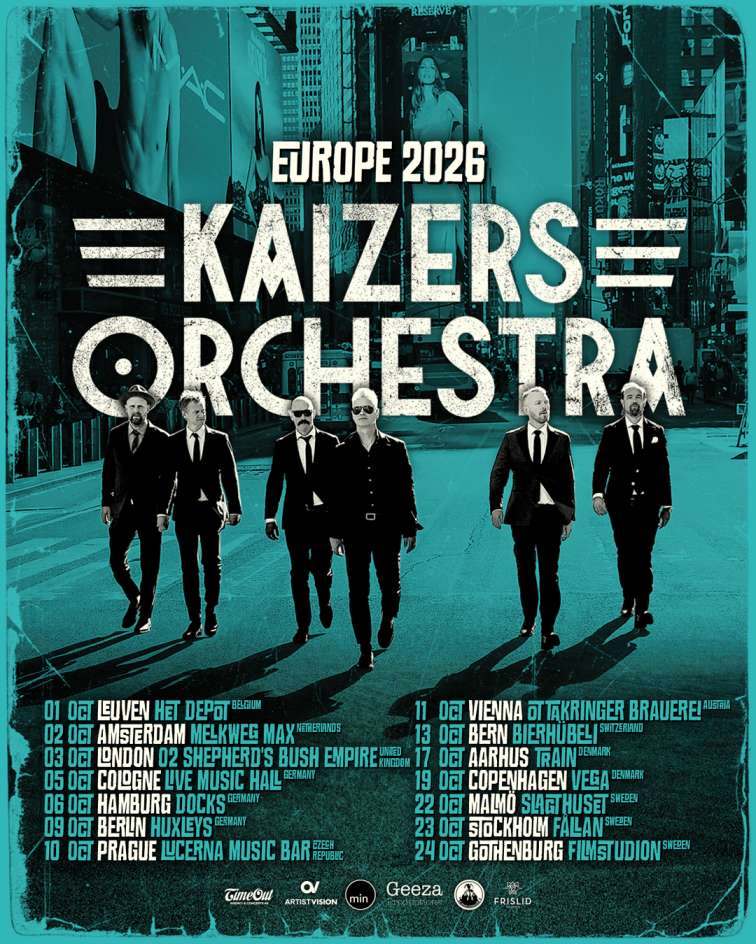
After the scale of your stadium shows in Norway last summer, what inspired the decision to return to smaller club venues across Europe in 2026?
Hi there, all is well in the Kaizers camp. It’s been a busy couple of years, so we’re all enjoying putting our minds and time into other things for a while.
As for the upcoming European tour, it has been in the pipeline since day one of our comeback. From the start, we wanted to do everything twice: the club tour in Norway, Europe, and the US — and then do it all over again with festivals and stadium shows in Norway, a return visit to New York, and now finally wrapping up the whole comeback with this second and final European tour.
It’s always a highlight.
How does the energy of an intimate club show differ from playing arenas or stadiums for Kaizers Orchestra?
Well, first of all, it’s amazing that we’ve reached a point where we can actually do both formats — and everything in between. That mix and balance is really what makes us tick. None of us would want to do the same thing over and over again, so this diversity in how we present our show is essential to our continued existence as a band.
Remember, we stopped in 2013 because we couldn’t come up with new and greater challenges for the band at the time, and we all agreed that we’d rather stop than repeat ourselves.
Artistically, doing smaller and bigger shows is actually quite similar. The songs are the same, but naturally the production is much bigger at the stadium shows. On stage, I more or less feel the same either way — although I’m definitely someone who loves big crowds and enjoys helping thousands of people become one. I’m the bridge between the band, the music, and the audience. Connecting people.
Like Nokia in the nineties.
Do smaller venues bring you back to the spirit of the band’s earliest years?
In a way, yes. We all come from the small venues. That’s where everyone has to start — where you develop your craft, find your identity, and make all the mistakes. It’s where you grow together as a band, alongside the local promoter and the first fans, who often become the die-hard supporters we still recognize in the front row today.
So yes, it’s great to get back to the roots and create new magical moments in smaller venues — moments that soon turn into beautiful lifelong memories.
It’s also easier to hang out with people at smaller shows, both before and after the concert. We really love that too.
What emotions come with revisiting the kinds of rooms that helped build your reputation as a live act?
It’s great to revisit some of the venues we played while growing up. We meet many of the same people we knew back then.
As a fan, I would love to see my favorite artists in a smaller venue — you’re closer to the stage, it feels more intimate, more exclusive. As an artist, I’m very aware of that.
I’ve seen both Tom Waits and Nick Cave in smaller venues, like opera houses. Both shows were incredible, and I’ll never forget them.
Maybe we can give some of our fans that same feeling.
Kaizers Orchestra are known for explosive performances, so how do you adapt that intensity to a more compact stage?
I think for us, it’s probably easier to make a smaller room bounce than a big stadium. It’s more intense in a way. It’s packed and crowded — gritty, sweaty — and the sing-along hits us straight back in the face.
I remember being absolutely blown away by our fans at Sentrum Scene in Oslo during the comeback shows in the fall of ’23. The venue holds around 800 standing and 800 seated in an amphitheater setup, so it basically became a wall of singing people right in front of us. Not much can compare to that kind of impact. It was ridiculous.
Let’s hope some of the shows in October feel the same way.
How carefully did you choose the cities and venues for this run?
We have some obvious key cities that we always tour, like Copenhagen, Stockholm, Amsterdam, and Berlin, but the rest is usually a combination of what our promoter suggests and simple availability.
For us, it’s important to have a mix of familiar places and new ones. This is actually my favorite kind of touring — spending a month on a nightliner bus, waking up in a new major European city every day. Living the dream. Playing shows every night. Bring it on!
Were there any particular places you felt you had to return to on this tour?
Just the key cities I mentioned. We also decided to skip the very south this time. Like Spain, France and Italy. Maby next time.
How much of the debut album’s spirit still lives in the band today?
Good question. I think there’s still a lot of the same energy in the band today as there was on our debut album, because those songs were written to work live on stage. The album itself was also recorded live, and we still play about half of it today — with the same arrangements, the same sound, and still 100% live.
It’s probably much harder to recreate some of the later albums from the Kaizers catalogue on stage.
Will the anniversary influence the setlist for this tour?
Maybe a little bit. We’re not going to play the album from start to finish or anything like that. Our main focus is still to put together the best possible show and to keep making small variations from night to night.
But maybe we’ll throw in a surprise song here and there. We’ll look into that during rehearsals this summer.
Your question came a little early…
What do you hope younger fans, discovering Kaizers Orchestra for the first time, take away from these shows?
We’ve always aimed to be the most immediate, in-your-face, shockingly captivating live act on the planet — and that has nothing to do with hits in the traditional sense. For us, all of our songs are live hits.
We’ve rarely been played on the radio, almost never been on TV, we have medium-to-low streaming numbers and a pretty modest following on social media — no TikTok — yet thousands of fans show up at our concerts every night. We’re a no hit wonder.
It’s definitely a word-of-mouth kind of band.
And now the younger generation has been told by their parents, or by older brothers and sisters, to go see Kaizers Orchestra live if they want one of the most kick-ass concert experiences of their lives. So they listen to their friends and families and they show up.
That’s it. We’ve got them. They’re trapped. They become part of the tribe.
Welcome to the Kaizer family!
Finally, what do you have lined up next?
A new album.
Listen to Kaizers Orchestra below
More from Interviews

INTERVIEW: TATE SEDAR drops “Take It All Back”
Born in San Francisco, raised in London and now based in Los Angeles, TATE SEDAR has spent much of his …

INTERVIEW: Cinematic conceptual album from INYO
Coming out of Los Angeles, newcomer INYO is an artist whose musical vision is informed by a desire to explore …
INTERVIEW: Brand new single from Thomas Azier
Dutch singer, composer and producer Thomas Azier has spent the last twelve years making an impression in the European music …