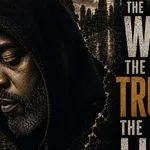







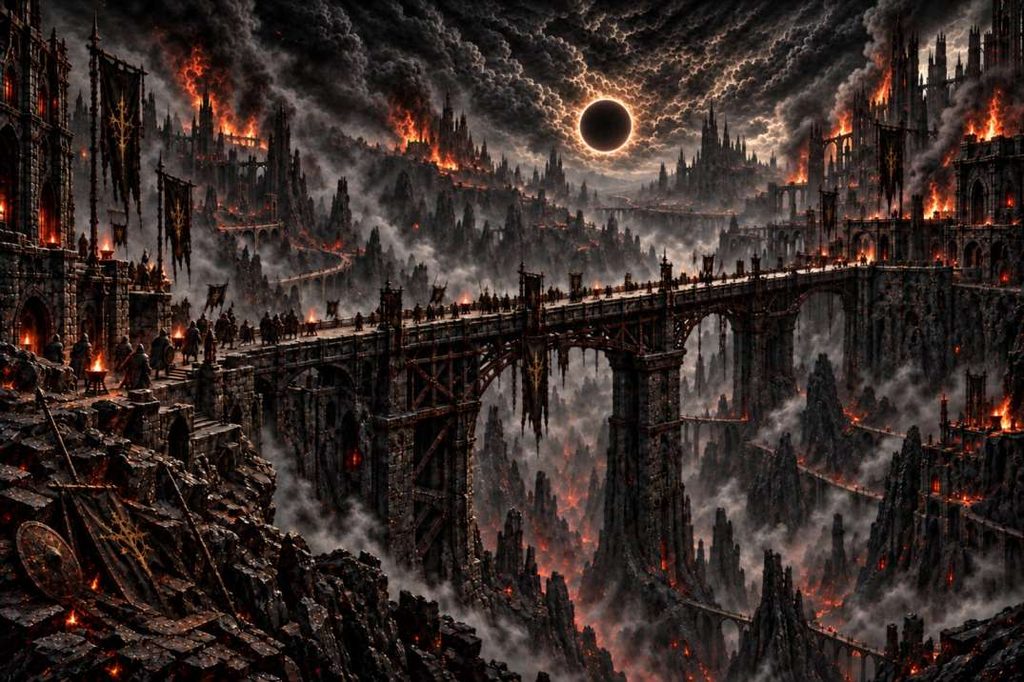
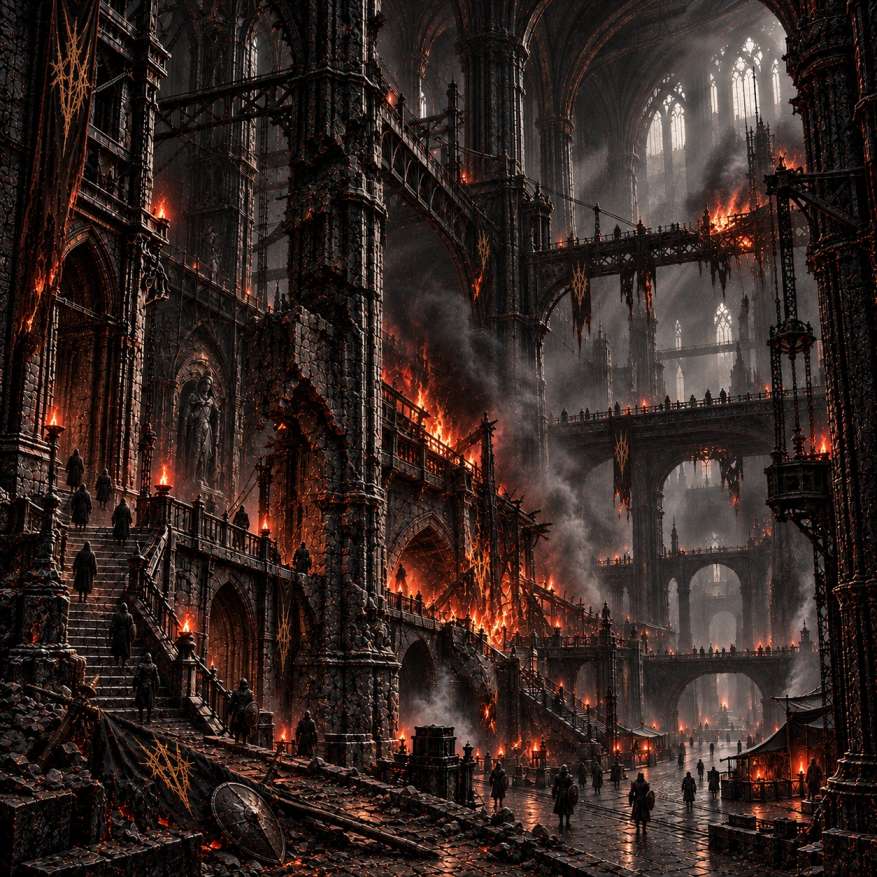
Based in Tbilisi, Georgia, Wildcard Campfire is a faceless cinematic heavy music project that brings together crushing riffs, haunting melodies and a story-focused world shaped by grief, rage, faith and determination. Written and creatively directed by guitarist, songwriter, composer, arranger and vocalist Rom Burla, the endeavour views heavy music as something larger than sound alone, with its songs forming part of an interconnected universe, where individual voices and personal experiences become fragments of a much wider story.
With the release of its debut album, Where God Grew Tired, Wildcard Campfire opens the door to a world where the boundaries between mythology, history and human experience are constantly shifting. Across ten tracks, Where God Grew Tired serves up a cinematic metal anthology that moves between melodic metalcore, deathcore, djent, progressive metal and post-metal atmosphere. Low-tuned guitars and raucous breakdowns provide much of its physical impact, while expansive melodic passages and orchestral arrangements give the record a sense of scale.
By not relying on a single sound or emotional setting, Wildcard Campfire channels contrast, allowing moments of brutality to sit alongside contemplation, humour and unexpected tenderness. The album’s central idea reaches beyond its musical construction; each track offers a window into a shared fictional world, exploring different eras, conflicts and lives without presenting its history in straightforward chronological order.
A promise gradually becomes doctrine, rebellion develops into war, and violence continues long after its original causes have been forgotten. As civilisation eventually destroys itself, humanity retreats underground, leaving new life to adapt above the ruins and thousands of years later, survivors return with an incomplete and distorted understanding of what came before them. The work revolves around The Ashen Gospel, a three-part sequence that follows the rise of rebellion, the burning of the banners and the final collapse of the old world. This story arc gives the album a sense of progression but the surrounding tracks continually shift the perspective.
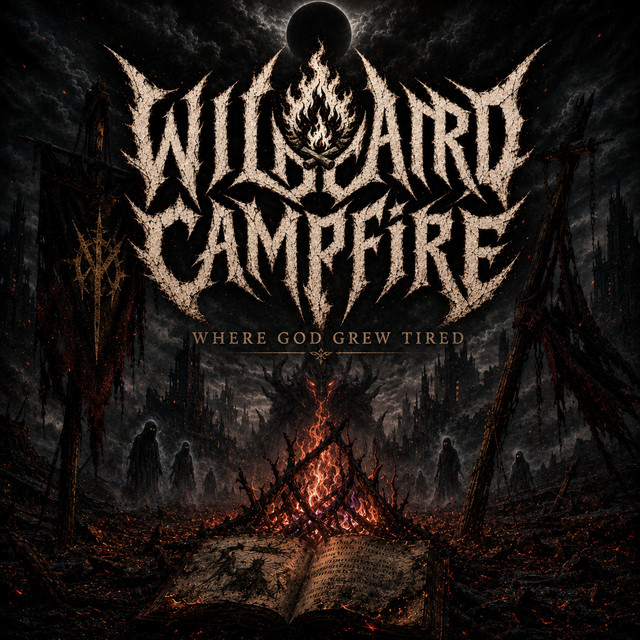
The album launches with “The Beast with My Name,” where a flurry of dancing lead guitar notes, crunching instrumentation, pounding drums, growling vocals bursts and dashes of orchestral elements give way to a charging metalcore outing that rolls with uptempo energy and multiple twists and turns. “The Ashen Gospel – I. Before the Banners Burn” then arrives with choral vocal layers and narrating leads as rumbling drums usher in intricate guitar leads to set up a cinematic metal voyage brimming with intensity and the gripping interplay between aggressive vocal leads and the melodic choir of voices.
Wildcard Campfire also reveals a desire to move beyond the expected frame of its heavy sound, with “Khinkali Inferno” introducing feral humour and human connection through a meal shared between battles, wrapped up in an enthralling outing cut with belted vocals, gritty guitars and punching percussion. “The Ghosts of My Past” thematically confronts the simmering presence of guilt and trauma, offering a shift in tone that’s central to the album’s wider perspective that frames conflict as not confined to battlefields but as something that can also survive within families, institutions, relationships and the memories people carry.
“The Ashen Gospel – II. When the Banners Burn” delivers a truly cinematic listening experience where bouncy metal riffs, swells of vocal layers and roaring vocal leads collide in spectacular fashion. “Paradise Has Walls” transforms social and religious pressure into an intimate siege while revealing the more melodic side of Wildcard Campfire, offering an anthemic outing packed full of memorable songwriting and delicate moments that contrast surges of sonic impact and flashes of exquisite lead guitar flourishes.
“The Legend of the Shanenigator embraces deliberately absurd storytelling, turning domestic chaos into another piece of the project’s mythology while “Shackles of Blood” examines what happens when violence becomes embedded within an individual. Closing the release with the title track and the finale of the interconnected triptych, “The Ashen Gospel – III. Where God Grew Tired” delivers one last exhilarating ride through flickering lead guitar, beating drums and dazzling passages of choir-led vocal sections, concluding the work in a thoroughly engaging way.
Ultimately, Where God Grew Tired is built around the tension between the opposing forces of melody and aggression, personal detail and apocalyptic scale, despair and endurance. Through Rom Burla’s approach to songwriting, arrangement and world-building, Wildcard Campfire presents a debut in which every track contributes to something larger than itself via a record concerned not only with how worlds collapse but with what remains in the people who survive them.
We caught up with Wildcard Campfire to find out more about the project’s musical journey so far, the debut album Where God Grew Tired and what’s lined up for the future. Check out our interview with Wildcard Campfire below.

Hey Wildcard Campfire, how’s things?
Hey! All good, thanks! Things have been pretty busy lately between family, running my business, and everything happening around the album, but I’m really enjoying it. It’s amazing to finally see something I’ve worked on for so long out in the world and starting to reach people.
What’s your earliest memory of making music?
One of my earliest memories goes back to when I was ten years old and studying guitar at a music school. We had an end-of-year performance, and I was playing Jimi Hendrix’s Third Stone from the Sun with a band from the school.
There was a section where I was supposed to improvise a guitar solo. Now, imagine a ten-year-old kid performing in front of an audience for the very first time, nervous as hell, and suddenly having to improvise. Somehow, I ended up soloing over two sections of the song, even though only one of them was actually meant for my solo. Apparently, even back then I had trouble knowing when to stop playing! Haha.
But the first time I actually wrote a song was when I was fifteen, with a good friend of mine. We were heavily influenced by the metalcore scene of the 2000s, especially Killswitch Engage, and decided to try writing something of our own.
We enjoyed the process so much that one song turned into another, and then another, until eventually we had an entire album. Unfortunately, it was never recorded or released, but I think that was the first time I really understood how much I loved not just playing other people’s music, but creating something of my own.
Which artists do you draw most inspiration from?
Wow, that’s a tough one, because I listen to so many different kinds of music.
If I think about the artists who have influenced me the most over the years, Killswitch Engage, Opeth, Dream Theater, Deep Purple, Pink Floyd, Metallica, TesseracT, Make Them Suffer, and Falling in Reverse all come to mind, especially Falling in Reverse’s material since Popular Monster.
But my influences definitely don’t stop at metal. I’m a huge fan of Jimi Hendrix, Stevie Ray Vaughan, and Joe Bonamassa, as well as artists from completely different musical worlds, like Eminem, Bach, and Hans Zimmer.
I think a lot of that comes from the household I grew up in. My parents listened to a lot of music, and my dad especially loves classic rock, progressive rock, and blues. Those genres were always part of the soundtrack of our home. My parents also went through a phase where there was quite a bit of grunge playing around the house.
So for me, there was never really a strict separation between musical styles. There was always room for a heavy riff, a blues guitar solo, a long progressive composition, or something completely orchestral.
That’s probably one of the reasons I don’t like restricting myself too much when writing music.
How else do you find inspiration for your music?
Pretty much everywhere, actually.
Personal experiences, people I meet, things happening in the world, history, travelling, conversations, films, and sometimes even the smallest things that happen in everyday life.
I think what fascinates me most is human behaviour. How people react to fear, love, power, loss, or changes they have no control over.
But what I really enjoy is that inspiration can come from completely different places, and you never quite know where an idea is going to lead.
For example, Paradise Has Walls came from a very personal experience involving my wife and me. We were born in different countries and met when she came for a short visit to the country where I was born. Afterwards, we had to deal with laws and bureaucracy that kept us apart for months. I took those feelings and turned them into a fictional story about two people trying to be together in a world where laws and borders keep separating them.
Make It Pop, on the other hand, came from somewhere a lot less romantic! Haha.
I also work as a software developer, and over the years I’ve dealt with my fair share of endless requests for changes and revisions, sometimes to the point where the original idea almost disappears completely. I took the frustration and absurdity of those situations and turned them into an absolutely over-the-top deathcore song, where a council of creatures in a post-apocalyptic world keeps demanding more and more revisions until there’s barely anything left of the original creative vision.
I think those two examples give a pretty good idea of how my brain works when I’m creating. One idea can come from something deeply personal and emotional, while another can come from an everyday frustration that I decide to take in a completely absurd direction.
As long as there’s an emotion behind an idea, or something I find interesting to explore, I enjoy discovering where I can take it through music and storytelling.
Wildcard Campfire has a faceless identity. How has removing the conventional artist persona affected the way you write, and does it give you more freedom to explore thoughts or emotions you might otherwise keep private?
I don’t think choosing a faceless identity has changed the emotions I want to express through my music, but it has definitely given me more freedom in how I can present them.
To me, being faceless doesn’t mean there’s no real person behind the project or that my identity is a secret. It’s primarily an artistic choice that allows the music, characters, and worlds to take centre stage.
By not making myself the main character of the project, I can let fictional characters speak in their own voices, even when they see the world very differently from me or make decisions I completely disagree with.
There’s also freedom in the project’s visual identity. I don’t want to be tied to one particular appearance or character forever. As the worlds of Wildcard Campfire change, the aesthetics and the way they’re presented can change with them.
That doesn’t mean there’s no personal connection between my life and the music. There absolutely is, and sometimes it’s a very deep one. But I’d rather listeners enter those stories through the music and characters, rather than necessarily through my face or personality.
I think that gives both me and the listeners a lot more freedom.
When a Wildcard Campfire song begins to take shape, what usually comes first: a lyric, a melody, a particular emotion, or an idea that belongs to the fictional world you’re building?
There’s no fixed formula, and that’s one of the things I enjoy about the process.
Sometimes everything starts with an idea for a story or a character, and then I try to figure out what kind of music would suit it. Other times, I have lyrics I wrote years ago, and I go back to them, rewrite them, and start building a song around them.
And sometimes it’s simply a riff or melody that I can’t get out of my head.
The thing that usually connects everything is the emotion I want to communicate. Even if a song starts with a riff, at some point I try to understand what feeling it creates and what I can build around it.
Once I have a direction, I start working on the guitar parts, structure, melodies, and how the vocals should fit into each section.
I actually like that there’s no single correct way to start writing a song. If I forced myself to follow the same process every time, I think I’d end up missing quite a few interesting ideas.
What would you say is the perfect setting for listeners to enjoy your sound?
I think the ideal first listen would be at night, with a good pair of headphones, a little darkness, and as few distractions as possible.
I love the idea of someone just allowing themselves to get lost in the album’s atmosphere without feeling like they need to understand every detail of the story.
On the other hand, if someone prefers blasting the riffs and breakdowns while working out or driving, that’s absolutely fine with me too!
As long as the music manages to take them somewhere.
How has your own style and sound evolved since you started out?
I think my style has evolved mainly as my musical taste has expanded, and as I’ve started understanding more clearly what I love about different genres.
As a kid, I grew up listening to a lot of classic rock, blues, and progressive rock, and the guitar was obviously at the centre of my musical world. Later, when I started writing songs myself, I was heavily influenced by the metalcore of the early 2000s.
Over the years, I got more into djent, modern metalcore, deathcore, and orchestral and cinematic music, alongside all the other styles I never stopped loving.
I think I used to focus much more on whether a riff sounded good on its own. These days, I’m also much more interested in its context. What comes before it, what comes after it, what emotion it communicates, and how it fits into the song as a whole.
The guitar is still at the heart of my songwriting, but today I feel much freer to use different instruments, melodies, and styles to get to the result I’m imagining.
I don’t feel like I’ve abandoned my earlier influences. They’ve just gained a lot more layers over the years.
Who would be your dream artist to collaborate with?
Honestly, I don’t have a specific dream collaborator in mind yet! Haha.
At this stage, the collaboration I’m dreaming about most is actually building a team around Wildcard Campfire. I’d love to eventually bring in musicians and vocalists who connect with the music and the worlds I’m creating, and hopefully even take it all to the stage someday.
I think once I get there, I’ll probably start dreaming about collaborations with some of the artists who inspired me growing up.
But right now, making that first step possible is already a pretty big dream on its own, and I’ve got more than enough plans to keep me busy for the next few years!
How did you find making your new album ‘Where God Grew Tired’?
It was one of the most rewarding creative experiences I’ve ever had, but definitely one of the most complicated too.
It wasn’t just a matter of writing and producing ten songs. I also had to create an entire world around them, understand its history, the connections between characters, the events unfolding over thousands of years, and how each song fits into the bigger picture.
There were quite a few times when I was really happy with a song on its own, but still felt that something needed to change for it to better match what I had imagined.
And I had to balance all of that with my family and running my business, so I couldn’t always sit down and work on music for hours at a time the way I would have liked.
But I think that’s also part of what made the experience so meaningful to me.
The moment I could finally listen to the album from beginning to end, knowing that this entire world no longer existed only inside my head, was something special.
After all those years of having musical ideas sitting in a drawer, the fact that this album actually exists and other people can listen to it is something I don’t take for granted.
What message did you want to get across with this release?
I think if there’s one central idea running through the album, it’s our ability as human beings to justify almost anything when we’re convinced we’re doing the right thing.
The story begins with promises of safety, peace, and a better future, but over the years those same promises turn into systems of control, blind faith, and wars that people continue fighting long after they’ve forgotten why they started.
I wasn’t interested in presenting the world as a simple story of good guys versus bad guys. I wanted to explore how decisions, beliefs, and fears can affect entire generations, and how even things that appear hopeful can be far more complicated than they initially seem.
But I don’t want to dictate one particular conclusion that listeners are supposed to take away from the album.
If it makes someone question human behaviour, power, or the things we choose to believe in, that already means something to me.
How much of the fictional world is mapped out in advance? Do you have an overarching narrative that guides the music, or do individual songs gradually build the mythology as new ideas emerge?
It’s a bit of both, but there is definitely an overarching framework holding everything together.
For Where God Grew Tired, I developed the civilization’s history and its major events, from the rise of the False Prophet through wars that continue for generations, all the way to the destruction and what comes afterwards.
That timeline gives me a framework in which I can place different stories. Even when a particular song doesn’t directly describe one of the major events, it’s important to me to understand when it takes place and how the surrounding world affects its characters.
But that doesn’t mean every detail is decided in advance or that there’s no room for changes.
Sometimes, while working on a song, I discover that its original idea can take on a different or much bigger meaning within the world. Something that started as a personal or local story might become part of a much broader pattern happening across different parts of the civilization.
I like that balance. On one hand, I have a clear foundation that keeps the world consistent. On the other, there’s enough room for new ideas to develop naturally.
I think if I planned every single detail in advance and never allowed myself to change anything, I’d lose a big part of the fun of creating.
What artist have you been listening to most recently?
Lately, there’s been a lot of Falling in Reverse, Make Them Suffer, Polaris, and TesseracT in my rotation, but somehow Yngwie Malmsteen has also found his way back in recently.
Deep Purple and Metallica will always be there, and Joe Bonamassa is someone I keep coming back to. I honestly feel like he just keeps getting better with every release.
I’ve also discovered an artist called Dave Monroe who makes some really good grunge rock. His music reminds me of a lot of the stuff I listened to growing up. My parents had a period when they played quite a bit of grunge at home, so there’s something about that sound that takes me straight back to my childhood.
And the funniest part is that my eighteen-month-old son absolutely loves Slaughter to Prevail and Falling in Reverse. Their music is actually one of the best ways to calm him down or get him to sleep, and when he’s in the right mood, he goes completely crazy dancing to it!
Apparently, he’s decided to start his musical education at the heavier end of the spectrum!
What’s the main thing you want people to get out of listening to your music?
First and foremost, I want them to enjoy it and feel something.
It could be a riff that makes them bang their heads, a chorus that gets stuck in their heads, a moment that reminds them of something in their own lives, or a story that makes them think.
As far as I’m concerned, you don’t need to know all the lore to enjoy the music. Anyone who wants to dive deeper can, but it’s certainly not an entry requirement.
One of the things that makes me happiest is when someone tells me a particular song connected with them in a way I hadn’t necessarily considered when writing it.
I love the idea that people can take my music to completely different places and find something of their own in it.
If Wildcard Campfire allows you to explore parts of yourself through fiction, is there something you’ve discovered about your own creative instincts, emotions or experiences that you might not have reached through a more direct, autobiographical approach to songwriting?
That’s a really interesting question, and I think one of the things that became much clearer to me while working on the album is just how drawn I am to contrasts, not only musically, but also in the way I look at characters and human behaviour.
I keep finding myself interested in places where seemingly opposite emotions exist side by side. Power and fear, hope and despair, love and anger, or even people’s ability to do terrible things while genuinely believing they’re acting in the name of what’s right.
When I’m writing something directly autobiographical, my perspective is naturally limited to what I experienced and how I understood things at the time.
But with fiction, I can take that same emotion and try to understand it from a completely different perspective. Sometimes through a character I relate to, and sometimes through someone whose choices I completely disagree with.
I think that’s one of the things I find most interesting about the process. Trying to understand what drives a character to act in a certain way, even when I don’t necessarily agree with them. Not to justify their actions, but to understand what led them there.
While working on Where God Grew Tired, I also realized that I don’t have to choose just one side of the human experience. I can explore dark and heavy subjects while still making room for hope, love, and humour, without feeling like that takes away from the meaning of the work.
That’s something I want to carry into the future worlds of Wildcard Campfire as well.
For me, fictional storytelling doesn’t distance me from my personal emotions. Sometimes it actually helps me understand them better, because it allows me to look at them from the outside, through characters and circumstances completely different from those I’ve experienced in my own life.
Who would be 3 artists to headline your dream festival? And where would it be?
Wow, that’s a great question, and a really difficult one!
I think I’d go with Falling in Reverse, Killswitch Engage, and TesseracT.
It might sound like an interesting combination, but to me, it has pretty much everything I love about heavy music: strong melodies, insane riffs, musical complexity, energy, and a whole lot of character.
As for the location, I’d hold the festival in the wine region of Kakheti, Georgia.
It’s one of the most beautiful places I’ve ever travelled through, and I can just imagine a massive stage surrounded by vineyards, that incredible scenery in the background, and all three bands performing there.
Actually, now that I think about it, I really want to go to that festival myself! Haha.
Finally, what do you have lined up next?
There are still a few things I want to do around Where God Grew Tired, including the Lore Book and lyric books, a Deluxe Edition with additional material, and some guitar and vocal playthroughs that I’m working on figuring out how to release without compromising the project’s faceless identity.
But at the same time, I’ve already started working on the next world of Wildcard Campfire, and it’s going in a very different direction. This time, I’m focusing on a dystopian setting with a more psychological and clinical atmosphere, beginning in the near future and exploring identity and the way people experience and interpret reality.
I’m still in the writing and world-building stages, so I don’t want to reveal too much or commit to details that might still change.
In the long run, the dream is to reach a point where I can dedicate much more time to the project, work with real musicians and vocalists, and start exploring the possibility of bringing the music to the stage.
But for now, I just want to keep building it the right way, enjoy the creative process, and not feel like I have to rush into the next thing just to keep up with some release schedule.
I’ve got plenty of ideas, and I really think Where God Grew Tired is just the beginning.
Listen to Where God Grew Tired below
More from Albums
New full-length record from Divergent
While some musical ambitions take a little longer to find their moment, the journey for Iowa-based trio Divergent has been …
New album from Ashot Danielyan
Based in Moscow, pianist, composer and improviser Ashot Danielyan has spent more than a decade developing a musical output that …
Bryan Howell returns with new studio album
Originally hailing from central New York and now based in Nashville, Bryan Howell has spent more than a decade developing …