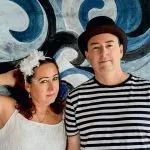
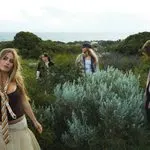
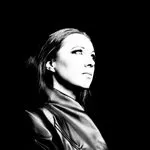

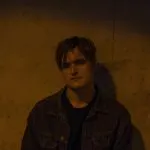
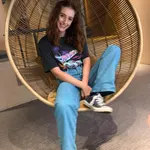


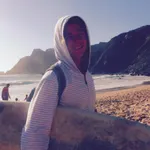
Hailing from San Francisco, Davia Schendel is an all-round creative talent who writes, creates music and makes films to deliver her own unique artistic vision. Often themed on existentialism, nostalgia and surrealism, she uses her talents as a vocalist, bass player, guitarist and producer to craft her alternative indie pop sound.
After making her studio music entrance in the summer of 2021 with her debut single “Helena Lives In Her Mind”, she’s released a string of dazzling songs and remixes that have seen her featured by the likes of She Shreds Magazine and Soho Radio among many other outlets. Now currently working on her debut full-length record, she brings us her latest work with the single “Dream of 1988”.
Linking up with featured artists Max Havas as a guest vocalist and Phillip Greenlief on saxophone, with her new single Davia Schendel weaves a mesmeric sound of hazy psychedelic pop full of alluring melodic leads, swaying instrumental lines and tones drenched in reverb that stretches for miles. Capturing an energy that’s ethereal and immersive, on “Dream of 1988” she lays down a kaleidoscopic soundscape that showcases the depth of her creativity and builds excitement for her forthcoming debut album.
We caught up with Davia to find out more about her musical journey, her new single and what she’s got in store for the future. Check out our interview with Davia Schendel below.
Hey Davia, how’s things?
Hello! Things are quite good. Happy to be healthy and alive on this rollercoaster that’s been the 2020s. Thank you for having me!
Which artist first made a lasting impression on you?
Well, I have to say Prince, due to the fact that his chameleon-like mutability really fascinated me early on. Since my parents played his music for me all the time, I didn’t really have a proper image of him. He sang in all these different voices, from a soulful baritone to a sexy falsetto. I wasn’t really sure of his gender either, which is really fascinating if you think about it. And then as I got older, I was allowed to watch Purple Rain, and that was like a lightning bolt to my brain. In that movie he mythologized himself, his origin story, and his collaborators, which was incredibly powerful. I wanted to jump into the TV and live at First Avenue in 1984 – wear amazing clothing and dance all night. Also, my dad is from Minnesota, and grew up kicking around the same spots as Prince – which makes the connection to him personal. Then into my twenties, I really dove into his side projects and lesser known works, like the Versace Mixtape and remix EPs he worked on, and just started to be bowled over by his work as a producer. I use Linndrum samples in my own work because of Prince’s influence.
How did you first get into making your own music?
I started to formally write songs when I was 15. I just had started to learn how to play guitar and working with chord progressions illuminated the process for me. The first song I wrote was called “Colors,” which was this ballad about watching the sunset with an unrequited love interest. Songwriting became a really wonderful way to process all these new feelings that come with adolescence – attraction, rejection, et cetera. Then I began to work with Garageband and started playing around with samples and recording my voice – I really leaned into electronic conceptual work in response to listening to artists like Blood Orange, Lana Del Rey, Jessie Ware, Arctic Monkeys, Lorde, the 1975, Kimbra, Goldfrapp and St. Vincent. Luckily my teachers at school noticed this musical passion in me and whenever we had a creative assignment they let me do musical interpretations.
How has your sound progressed since you first started?
I think I have become more maximalist in my approach, thanks to the fact that I have more resources and more instruments I can play, like bass guitar. Also my lyrics are so much more existential now. 10 years ago I would not have been able to write a lyric like “Touching you is like an act of creation/but would be written off as simple stimulation,” which is part of the bridge on Dream of 1988. My approach to writing about love is so much more complex, more nuanced.
Regarding production: early on I was just using electronic drum samples, my voice, synthesisers and minimal guitar. I am more conscious of my arrangements, which can be a benefit or a hazard when you are trying to create. For example, if you are focused on the technical side early on in the writing process, you might miss out on a great lyrical phrasing opportunity. I try to keep my initial demos very fluid and let myself wander a bit. It’s okay if it’s messy – and then I start to sculpt it more as I add more elements. Sometimes the first idea is really great, and I try to build on it, not deter from it.
What was your biggest artistic highlight from 2022?
Releasing my song “Dream of 1988” in November of 2022. The song was born in January 2021, and then in June 2021 Max Havas recorded his vocals, and then in January 2022 Phillip Greenlief came and put down his saxophone part. Then I tinkered with the mix and vocal arrangements for another 9 months- it sounds like an eternity, but I was really protective of this song, and I was so happy to finally release it. It always had an autumnal, or winter-esque introspective energy to it, so the timing was right when it ultimately was shared with the world. And of course, creating the promotional materials around the single was an exciting process. Visually, I have been alluding to this neo-noir 21st century protagonist who is seemingly signing up for a simulation test trial. In short, I’m preparing you all for what’s to come creatively this year.
Which artist do you draw most inspiration from?
So many artists have inspired me along the way. I would say my main touchstones for musical inspiration are Prince, The Beatles, HAIM, Dev Hynes, Jessie Ware, Suzi Quatro, St. Vincent, Patti Smith, David Bowie, Roxy Music, Sade, Duran Duran, Depeche Mode, Jam & Lewis, Beach House, Grace Jones, Peter Gabriel, Ella Fitzgerald, The 1975, Vangelis and so many others. Visually, David Lynch, Wong Kar-wai, Nan Goldin, George Segal, Maya Deren, Robert Wilson, Agnes Varda, François Truffaut, Eric Rohmer, Robert Rauschenberg, Andy Warhol and others.
What would you say is the perfect setting for listeners to enjoy your sound?
Walking around a city at sunset. I say that because it’s the closest thing you can get to experiencing “cinema” in real time – stories unfolding in front of you, lighting changes thanks to the streetlights or the actual sky; rhythmic pace thanks to your footsteps. Also, it’s in that setting when a lot of musical ideas come up for me. Urban isolation is something that we are all still processing as a society, and I do that through song. I think my music is made for introspection, at least for now. Even my songs that feel more grandiose have to contain a twinge of melancholy. It’s just the way I am.
What was the inspiration behind your new single “Dream of 1988”?
My yearning to travel back in time is the core of the song, in order to escape. I wrote the lyrics after taking a walk around my New York neighbourhood in early 2021 and was just stunned at how quiet the city was. It felt like an irreversible silence. We collectively were shell shocked from the first year of the pandemic, as well as from the nail biting election the previous autumn, from all these massive global events. People were calling me, worried about my safety in what used to be such a bustling city. But I knew how to keep myself busy and while working from home, I indulged in learning about New York’s cultural past. I had this used coffee table book documenting parties in 1980s downtown New York and was envious of how free and liberated everyone looked. But that was just a fantasy I created because of my own isolation during quarantine. The truth is that socially and politically, the 1980s were generally conservative, but you had these amazing cultural responses promoting diversity and inclusion against that normalised corporatization. So the lyrics reflect my fantasy of that time as well as a desire to live in an ideal dream world, as I was sequestered from the present day in order to survive.
As for the music, I was participating in this month-long online challenge arranged by She Shreds Media, an amazing femme and gender expansive musician’s magazine. My riff of that day became the bass line for “Dream of 1988.” I decided to add those lyrics to the bass line and synth track, and the song was born.
How do you find collaborating with other artists compared to working solo?
The variety of ideas that come from collaboration pale in comparison to working alone. If you have a lot of time, you can meditate and accumulate ideas, but with a group or with others it becomes so exciting. Of course, the communication aspect is key – so I find that writing songs with larger concepts really suit a group session. If it’s an intimate ballad that feels singular and personal, I tend to be really protective of it. But that’s regarding the writing process- if it’s a question of instrumentation and musicianship, I’m always excited to hear ideas – without the collaborative efforts of Max Havas’ vocals and Phillip Greenlief’s saxophone contributions on “Dream of 1988,” the song would not be the same. Their musical gifts to the song give it that cinematic narrative that I wanted from the very beginning.
What artist have you been listening to most recently?
A recent discovery of mine is Bat For Lashes. I am a bit upset that it has taken this long for me to find her, but she is really a fantastic alternative artist from the UK who is now based in Los Angeles. She works in a similar headspace as mine – nostalgic, cinematic and surreal. I also love Caroline Polachek’s latest song, “Welcome To My Island” – a real song you can belt to and feel release while singing. Also the remix by Charli XCX and George Daniel is a stunner.
What’s the main thing you want people to get out of listening to your music?
I want them to feel like they are dreaming, or are accessing this unnameable source of themselves. If my music makes you feel like a main character of an arthouse film, I think that’s a good way to frame the intended effect. And I want my music to validate the feelings of those who are a little more sensitive, a little more melancholy than the rest. I want my music to send the message that it’s all right for us to be blue and feel a little more intensely about life than most people do.
What’s been your favourite live show so far?
I think highlights for me were playing Bottom of the Hill in San Francisco in September 2022, the Map Room at Bowery Electric and the Mint in Los Angeles in April 2022. Lots of long time friends in those rooms and I really had the intention of letting loose at both shows, which helped. When you are onstage, you have this duty to really shed some of your metaphorical skin for the audience, otherwise if they sense your discomfort, they feel the same. Your audience becomes your mirror, they are there to witness you transform so they can feel that internal evolution happen as well. So I felt really comfortable in both of those spaces and feel like I was evolving on stage.
Who would be 3 artists to headline your dream festival? And where would it be?
I would love to see HAIM, Dev Hynes and Christine and the queens headline, and then do an hour long set together afterwards. Can you imagine? Honestly, if they did an album together that would be my dream as well.
Do you have any advice for a new artist wanting to follow your footsteps?
Well, I’m sure this is something most people say, but if you have any niche interests that divert from the aesthetic status quo, use that to define your image. Also, with that being said, find collaborators who are excited about your vision and want to work with you to establish your sonic and visual world.
Finally, what do you have lined up for 2023?
A few music videos. A few more singles. Getting the album ready for release. More shows in new cities! Staying healthy and grounded.
Listen to Dream of 1988 (feat. Max Havas) below
More from Interviews
INTERVIEW: TATE SEDAR drops “Take It All Back”
Born in San Francisco, raised in London and now based in Los Angeles, TATE SEDAR has spent much of his …
INTERVIEW: Cinematic conceptual album from INYO
Coming out of Los Angeles, newcomer INYO is an artist whose musical vision is informed by a desire to explore …
INTERVIEW: Brand new single from Thomas Azier
Dutch singer, composer and producer Thomas Azier has spent the last twelve years making an impression in the European music …