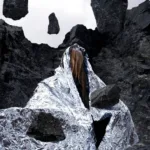




















Growing up in the remote Finnish countryside, Helsinki-based artist Conchis found music in the spaces between everyday life and imagination. With few distractions in her surroundings, it became a creative lifeline, offering an opportunity to explore emotions and ideas that stretched beyond the limits of her immediate environment. Beginning with violin lessons at the age of seven, she later joined a choir before picking up the guitar at fifteen, developing a musical vision that would eventually take shape through an adventurous blend of electronic pop, experimental production and cinematic atmosphere.
Today, her work simmers in a space between light and darkness, beauty and disquiet, with psychological complexity and personal transformation running throughout. The name Conchis, borrowed from the mysterious character in John Fowles’ novel The Magus, feels particularly appropriate for an artist drawn towards ambiguity and the blurred areas between opposing ideas.
Her first musical offering arrived in 2024 with debut single “Cray Cray,” the first showcase of a creative world which was explored more fully on debut album Chapters. Moving through themes of loss, yearning and pain, the record revealed a songwriter seeking to confront difficult emotions by balancing pain with strength and reflection.
With her highly anticipated sophomore album Gravity, Conchis now takes that exploration into more personal spheres via an electronic alternative pop record created under extraordinary circumstances. Its origins sit in a severe ME/CFS crash that left her unable to play instruments, use a computer or even listen to music. With the usual tools of songwriting suddenly unavailable, she found another way to keep creating and while lying on a bathroom floor, she began composing songs entirely in her mind, initially as a way to occupy herself through the monotony of illness.
Every element of Gravity was constructed internally before Conchis was well enough to record, with melodies traced through memory, basslines imagined through sensation and lyrics and arrangements developed in silence. Each song was effectively completed in her mind before she could bring it into the physical world and as she explains, “I couldn’t make music the usual way. I had to find another way.” When her strength eventually returned enough to work again, she translated that private musical landscape into sound, creating a record shaped by stillness but driven by a steadfast sense of intent.

Thematically, Gravity examines the forces that pull us down, from time, circumstance, relationships, expectations and the limitations of the body itself. That tension runs throughout the album’s imagery, where battlegrounds, walls, roads, stones and barriers sit alongside feathers, rain, angels and the possibility of floating beyond earthly weight. Time becomes equally unstable, shifting between moments that race forward and periods that seem to stretch indefinitely.
Opening track “Beginnings” captures the frustration of being caught in a life that’s yet to resume, its hesitant movement leaving space for the chance of change without promising an immediate breakthrough. With soft synth pulses contrasted by the rattle of stuttered beats, the track glides with stretching vocal layers which twist above bursts of glitching rhythms, intricate guitar notes and consuming low end energy, resulting in a transportive alternative pop soundscape that’s mesmeric and unnerving in equal measure.
“Beggars” follows as a confrontation of the limitations imposed by chronic illness, exchanging idealism for acceptance, captured in a more minimal soundscape where deconstructed club energy flows with rumbling rhythms and enticing vocal leads. “Easy Easy” weighs up the difficult process of letting go of old ways of thinking, while “Streetlights” draws listeners into a hypnotic electronic landscape of pattering percussion, swelling synths and deep bass-driven aesthetic. “It Will Only Hurt Once” builds from fractured rhythms and brooding electronic details into an emotionally charged arrangement, with production by Jonas Verwijnen preserving its intensity while adding subtle impact.
On “Kicking and Screaming,” anxiety becomes the driving force, reflected in a jittery structure that tightens its coiled grip without ever fully exploding. The album closes with its title track, “Gravity,” which draws on experiences of feeling detached from the body to explore the space between weight and weightlessness, eventually arriving at a sensation of floating somewhere between the ground and the sky. With buzzy synth elements, chanted vocalisations and the hurried march of drums, it’s a memorable finale that concludes the sensational sophomore record from Conchis in spectacular fashion.
Gravity is ultimately about reconsidering what it means to move forward when life throws unexpected hurdles in your path and across an album born in silence, Conchis delivers a powerful musical statement that’s at once enjoyable and profound. Commenting on the album, Conchis shares, “I think Gravity is a more cohesive record than Chapters. Chapters came from many different places, like different chapters of my life, whereas Gravity grew out of one particularly difficult period, so there’s a stronger thread running through it. It’s understandably a bit darker, but I also think it has more resilience in it.”
Listen to Gravity below
More from Albums

Kitty O’Neal drops debut studio album
London-based singer-songwriter Kitty O’Neal views songwriting as an exercise in finding the extraordinary within the everyday, turning personal experiences into …
New album from Andy Welsh
The music of Andy Welsh has always been closely tied to identity, place and the people encountered along the way. …

Debut album from Melody Briar
Some songs begin with a melody, others with a lyric or a brief idea waiting to be developed but for …