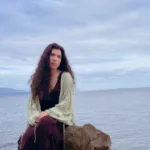




















Some songs begin with a melody, others with a lyric or a brief idea waiting to be developed but for Massachusetts-based songwriter Melody Briar, the creative process reaches further back, shaped by years spent studying piano, voice and classical repertoire. Her musical output carries the patience of a composer alongside the openness of a storyteller, allowing music to arise from the keyboard before finding its lyrical form.
Working across indie pop, indie rock and singer-songwriter stylings, Melody Briar explores grief, love, memory and the complicated process of learning to live alongside loss. There are echoes of artists such as Phoebe Bridgers, Lana Del Rey, Caroline Polachek and The Cranberries in the musical landscape surrounding her work but her songwriting is marked by a philosophical reflection and a particular sense of emotional gravity. Not viewing difficult subjects from a afar, she draws directly from personal experiences of loss and transformation, finding ways to make individual memories speak to something more relatable.
That impulse became especially important after a profound personal loss prompted Melody to begin writing original music as a means of processing what had happened. Songwriting offered a way to examine feelings that might otherwise remain difficult to articulate, giving grief, remembrance and healing a place within a creative process. Her recent single, “The Intangible Man,” captured this approach through a combination of lyrical honesty and atmospheric production which won over listeners and tastemakers around the world.
Now, Melody Briar brings us her most ambitious artistic statement thus far with Green Aventurine, her debut full-length record which takes a wider and more sustained look at grief in all its forms. Penned in the aftermath of profound loss, it moves through sadness, longing, anger, tenderness, guilt, nostalgia and existential reflection without attempting to arrange those emotions into a straightforward narrative of recovery. The album recognises that loss is seldom something that can be neatly resolved and its presence changes over time, influencing how people understand their memories, relationships, identities and even their sense of time itself.

The sixteen-track album is built around piano-led songwriting, layered instrumentation and poetic lyrics, with atmospheric production providing a connective thread throughout. Melody’s classical background informs the sensitivity of the arrangements, while the songs retain the directness of personal storytelling intended to make room for thoughts and feelings that are often left unspoken, offering an honest account of loving someone, losing them and continuing afterwards. There is no attempt to manufacture an easy conclusion, with the emotional complexity of the subject allowed to remain intact.
The album’s final single, “Bellingham,” considers the way particular places can become inseparable from the people associated with them, turning cities, coastlines, photographs and ordinary locations into physical reminders of absence. Distance doesn’t necessarily diminish those connections; sometimes it makes them more immediate and through its exploration of place, memory and emotional attachment, “Bellingham” holds guilt and longing alongside the continuing possibility of connection.
Its arrangement brings together live piano, cello, violin, flute, layered guitars and evocative production, expanding the intimacy of Briar’s keyboard-led writing without losing its central focus. Produced by Michael Banks at YouTooCanWoo Studio and Shifted Recording Studio, the album features contributions from Aaron Stokes on cello, Jimmy Drancsak on violin, Kirk Schoenherr and Tom Wardle on guitars, Mattie Saferm on bass, Stuart Bogie on flute and saxophone with Neil Conti and Ethan Cohen on drums.
With Green Aventurine, Melody Briar continues to build a musical space in which difficult emotions can be examined with honesty as opposed to being simplified or concealed. Her songs recognise that remembrance and transformation are ongoing experiences, and that continuing forward doesn’t mean leaving everything behind. Commenting on the release, she shares,“When faced with the biggest loss of my life, I found grief to be confusing, chaotic, and deeply harrowing. Music was my only chance at self-soothing and making sense of what had happened. And so, this album was born from my darkest moments, but also the intense love I will always carry with me.”
Listen to Green Aventurine below
More from Albums
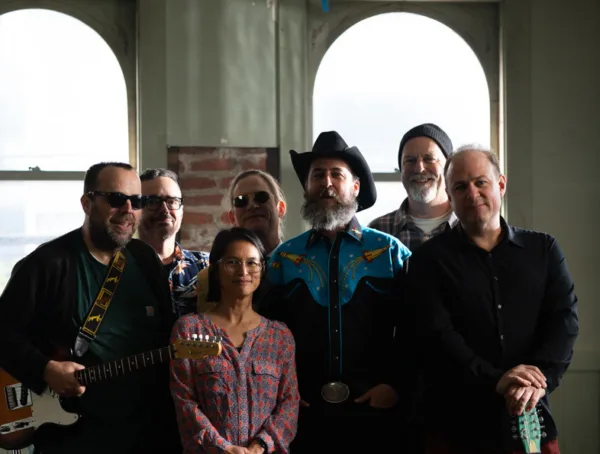
Brand new album from The Society of Rockets
Rising from San Francisco's underground music scene around 25 years ago, The Society of Rockets have spent their career following …

John Goldrust shares ‘Like A Phoenix’ album
Oxford-based singer-songwriter, guitarist and producer John Goldrust has spent much of his musical life exploring the space between known traditions …

INTERVIEW: FKA MASH drops debut album ‘EXITECHNO’
Growing up in Soweto in South Africa, FKA MASH discovered electronic music through the unlikely playground of early production software …